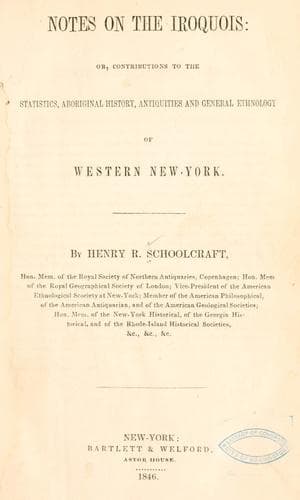
Notes on the Iroquois: or, Contributions to the Statistics, Aboriginal History, Antiquities and General Ethnology of Western New-YorkSchoolcraft, Henry Rowe
History
Notes on the Iroquois: or, Contributions to the Statistics, Aboriginal History, Antiquities and General Ethnology of Western New-York
Schoolcraft, Henry Rowe
Indians of North America -- New York (State); Iroquois Indians
But by far the most attractive class of fabrics which the commerce
of Europe supplied in exchange for their rich furs and peltries, was
arm-bands, wrist-bands, ear-rings, gorgets, and other ornaments, both
for the person and dress, of silver. This metal was esteemed, as it is
at this day, above all others. Its color and purity led them to regard
it as pre-eminently _the_ noble metal, and its introduction at once
superceded the cherished Nabikoagun Antique, and other forms of medals
and gorgets made from compact sea-shells.
In this manner the introduction of European arts, one after another,
speedily overturned and supplanted the ancient Indian arts, and
transferred them, at the end of but a few generations, from useful
objects to the class of antiquities. It is unnecessary to pursue the
subject to the department of clothing, in which woollens, cottons,
linens and ribbons, took the place of the dressed skins of animals and
birds, and the inner barks of trees, &c. Such objects are no part of
the antiquities to be studied here. They are wholly perishable, and
if any thing is to be gleaned from their study in the unburied cities
of Pompeii and Herculaneum, where stone and marble offered objects of
temporary resistance to currents of flowing lava, they offer no facts
to guide the pen of the antiquarian here. The European and the Indian
fabrics of the 16th century have alike submitted to the inevitable laws
of decomposition; but were it otherwise, could we disinter from the
Indian graves the first duffils, strouds, osnaburgs, and blankets, that
were given to the race, they would only prove that the latter quickly
laid aside the inferior when they could get the superior article. It
would prove that guns and gunpowder, brass kettles and iron axes, had
caused the manufacture of stone darts and clay kettles to be thrown
aside and forgotten, and in like manner the labors of the spindle and
loom had given the Indian, even before Columbus descended to his grave,
a new wardrobe.
To denote what the Indian arts were, at the beginning of the 16th
century, we must resort to their tombs, mounds, and general cemeteries.
The melancholy tale that is told from the dust and bones of these
sacred repositories is to be our teacher and schoolmaster. Its
whispers are low and almost inaudible. There are pauses and lapses
which it is difficult to make out. It requires great care—nice
attention—examination and re-examination. We must not hastily compose
the thread of the narrative. We must doubt and reject where doubt
and rejection are proper. We must discriminate the various epochs of
art from the objects disinterred. If objects of various ages lie in
the same cemeteries we must not confound them. Carefully to labor,
patiently to study, cautiously to conclude, is the province of the
antiquarian; and if, after all, he has but little to offer, it is,
perhaps, because there is but little to glean.
NOTE.
Public-domain text, read in full here on John Shaqi.
Reviews
Reviews
No reviews yet
Be the first to share your thoughts on this work.
Elsewhere in the archive
Join the Discussion
Join the discussion
Sign in to leave a comment or review.
Sign InorCreate an account