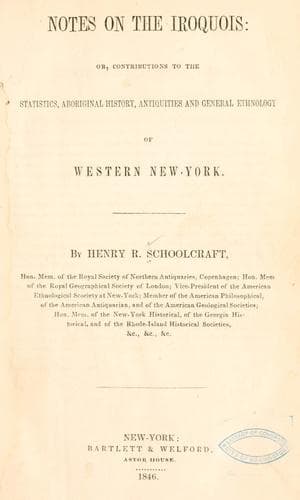
Notes on the Iroquois: or, Contributions to the Statistics, Aboriginal History, Antiquities and General Ethnology of Western New-YorkSchoolcraft, Henry Rowe
History
Notes on the Iroquois: or, Contributions to the Statistics, Aboriginal History, Antiquities and General Ethnology of Western New-York
Schoolcraft, Henry Rowe
Indians of North America -- New York (State); Iroquois Indians
[Illustration: AMERICAN ANTIQUITIES.—Plate X.]
CLASS FIFTH.—MINACE.[72]
[72] From Meen, a berry; and ace, a diminutive; hence minas or minace,
a bead, or an ornament for the neck.
Articles of this kind hold the relative character of modern beads or
necklace ornaments. They are made of shells, bones, fissile minerals,
sometimes pieces of calcareous or fissile crystal. The substitutes of
the European period are glass and pastes.
* * * * *
MINACE ALLEGHANIC. Fig. 6, Plate I. This article was first
disclosed on opening the Grave Creek mound, in the Ohio valley, in
1839, and received the false designation of “ivory.” It is figured
and described in the first volume of the Transactions of the American
Ethnological Society, published at New-York in 1845, where its
character is determined. It has often the appearance of having been
formed of solid masses of horn. It is believed to be, however, in any
case, a product of massy sea-shell. Decomposition gives its surface a
dead white aspect and limy feel. The powder scraped from the surface
effervesces in acids. It is generally, not uniformly, an exact
circle, and resembles extremely a very thick horn buttonmould. It is
characteristic of the orifice, that it appears to have been perforated
with an instrument giving a spiral or circular line. This ancient
ornament was also disclosed in my visit to the Beverly bone deposits of
Canada in 1843. Its occurrence, in Onondaga, denotes the universality
of the art, during the ante-European period.
CLASS SIXTH.—PEÄGA.[73]
[73] From _Peag_, one of the sea-coast terms of the Algonquins, for
wampum.
The ancient species of this article are numerous, and not exclusively
confined to sea shells. The Indian cemeteries denote it in the form of
bone and mineral.
* * * * *
PEÄGA IOWAN. Fig. 7, Plate 2. The material in this species
is the red pipe stone of the west, so much valued. It is perforated
longitudinally, and was evidently worn about the neck and breast like
the modern article of wampum.
CLASS SEVENTH.—MUDWÄMINA.
Ornament alone appears to have been the object of this numerous class
of remains. Generally the object was the production of a jingling sound
in walking. It was generally used to decorate some part of the dress.
It assumed a great variety of shapes, and was made from as many species
of material, including native copper. Another object was to inspire
fear by the tread.
* * * * *
MUDWÄMINA MISKWABIC.[74] Fig. 11, Plate I. The article figured
is three-fourths of an inch in length, bell shaped, and composed of
native copper, beat very thin. Onondaga.
[74] Copper.
* * * * *
MUDWÄMINA OSSINIC.[75] Fig. 8, Plate 2. Material, red pipe
stone, perforated. Onondaga.
[75] Stone.
* * * * *
Public-domain text, read in full here on John Shaqi.
Reviews
Reviews
No reviews yet
Be the first to share your thoughts on this work.
Elsewhere in the archive
Join the Discussion
Join the discussion
Sign in to leave a comment or review.
Sign InorCreate an account