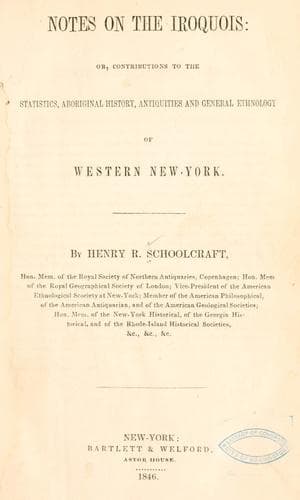
Notes on the Iroquois: or, Contributions to the Statistics, Aboriginal History, Antiquities and General Ethnology of Western New-YorkSchoolcraft, Henry Rowe
History
Notes on the Iroquois: or, Contributions to the Statistics, Aboriginal History, Antiquities and General Ethnology of Western New-York
Schoolcraft, Henry Rowe
Indians of North America -- New York (State); Iroquois Indians
MUDWÄMINA WASSÄABIC. Fig. 9, Plate 2. Material, a crystal,
perforated. Traces of its iridescence. Probably a crystal of strontian.
Onondaga.
CLASS EIGHTH.—OTOAUGUNA.
The name is derived from _Otowug_, meaning implements of, or relating
to the ear. It is a noun inanimate in _a_. Under this head all pendants
and ornaments for the ear are comprised.
* * * * *
OTOAUGUNA STATUESQUE. Fig. 3, Plate IV. This pendant for the
ear is made out of sea shell. It bears eight perpendicular and four
transverse dots. Locality, old fort, site near Jamesville. Onondaga.
[Illustration]
* * * * *
OTOAUGUNA PYRAMIDAL. Fig. 2, Plate I. This article varies
in size, in the specimens examined, from nine-tenths to one and
five-tenths inch, in the greatest length. It is an inequilateral
triangle, generally, as here shown, varying to a very acute truncated
prism reversed. Thickness from four to six lines. Perforated. Material,
red pipe stone. Locality, Onondaga county.
* * * * *
OTOAUGUNA BIFURCATE. Fig. 4, Plate I. Length eight-tenths
inch. Perforated. Red pipe stone. Onondaga county.
* * * * *
OTOAUGUNA QUADRALATERAL. Fig. 5, Plate 2. Material, red pipe
stone. Onondaga county.
CLASS NINTH.—ÆS.[76]
[76] Æs, a generic name for a shell—Algonquin.
The number and variety of sea and sometimes fresh water shells worn by
the ancient aborigines, has not been ascertained, but is large. They
are uniformly found to be univalves.
* * * * *
ÆS MARGINELLA. Fig. 10, Plate I. This species was first
detected in the Grave Creek mound. It is a marginella. The figure is,
incidentally, inexact. Onondaga.
CLASS TENTH.—OCHALIS.[77]
[77] From the Shawanoe word _Ochali_, a nose.
This class of ornaments were worn as pendants from the inner cartilage
of the nose. The material of nose-jewels in modern times, when worn,
is, generally, silver or some metal. Anciently bone or shell were the
chief substances.
* * * * *
OCHALIS ODÄ-Ä.[78] Plate 1, Fig. 3. The material is a part
of some massy species of sea shell. The outer coating is partially
decomposed, exhibiting an opaque, limy appearance. Length, eight-tenths
of an inch—rounded, heart-shaped. Onondaga. [J. V. V. CLARKE.]
[78] Heart-shaped, or like.
VII. ORAL TRADITIONS OF THE IROQUOIS—HISTORICAL AND SYMBOLICAL.
Public-domain text, read in full here on John Shaqi.
Reviews
Reviews
No reviews yet
Be the first to share your thoughts on this work.
Elsewhere in the archive
Join the Discussion
Join the discussion
Sign in to leave a comment or review.
Sign InorCreate an account