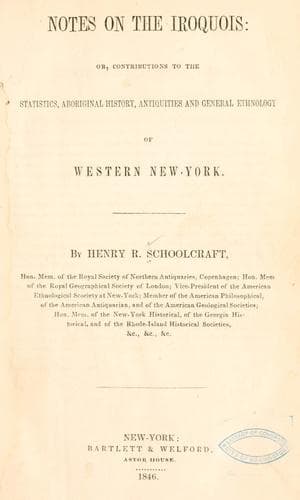
Notes on the Iroquois: or, Contributions to the Statistics, Aboriginal History, Antiquities and General Ethnology of Western New-YorkSchoolcraft, Henry Rowe
History
Notes on the Iroquois: or, Contributions to the Statistics, Aboriginal History, Antiquities and General Ethnology of Western New-York
Schoolcraft, Henry Rowe
Indians of North America -- New York (State); Iroquois Indians
The Tonawandas, who are Senecas, appear to have preserved more distinct
recollections of the origin of this war. HOHOEEYUH,[83]
stated to me, as did TETOYOAH, that it originated from the
contact of their hunting parties on the plains of the southwest. But
the latter affirms, that the Cherokees were the original offenders, by
robbing and plundering a Seneca hunting party, and taking away their
skins. Retaliation ensued. Tragic scenes of surprise and treachery soon
followed. The Five Nations took up the matter in all their strength.
They, contrary to what is above intimated, raised large war-parties,
and marched through the country to the Cherokee borders, and brought
away scalps and prisoners. There are now, he added, descendants of the
Cherokees in the third degree living on the Tonawanda reservation. Le
Fort, an Onondaga chief, speaking on the same subject, said that there
was, some years ago, a chief of pure Cherokee blood, by father and
mother, living among them. He had been taken captive when a mere child.
The fact being revealed to him after he had obtained the chieftaincy,
he went to seek his relatives in the south, and to live and die among
them; but after every inquiry, he was unable to find them. The memory
of the event of his loss was forgotten. He lingered a time, and then
came back to the Senecas, and died among them—an example of that
severe principle in the policy of this people, which has been before
referred to, under the term of WE HAIT WA TSHA, _i. e._ flesh
cut in pieces, and scattered amongst the tribes.
[83] J. A. Sandford.
Iroquois tradition on this subject is the same now that it was in 1794.
During this year, the interpreters told Col. Timothy Pickering, who was
a commissioner on the part of the United States, that there were then
living, warriors of the Six Nations, who had marched the whole distance
to the Cherokee county, and attacked the latter. In proof of the former
wars, they showed him a chief, who was a native Cherokee, born in the
Cherokee country, who had been captured when a boy, and invested with
this honor in mature life by the Senecas.[84] While the foregoing
tradition of living Iroquois is strengthened by this coincidence, we
are, at the same time, furnished by the latter with a proof that the
Iroquois policy was favorable to the rise of talent and bravery, and
that whatever be the checks provided by the TOTEMIC SYSTEM, on
the descent of chiefs, the elective feature was ever strongly marked
upon their entire government and policy.
[84] Yates and Moulton, p. 232.
[_d._] Embassy of Peace to the Cherokees, and Daring Feat of a Seneca.
Public-domain text, read in full here on John Shaqi.
Reviews
Reviews
No reviews yet
Be the first to share your thoughts on this work.
Elsewhere in the archive
Join the Discussion
Join the discussion
Sign in to leave a comment or review.
Sign InorCreate an account