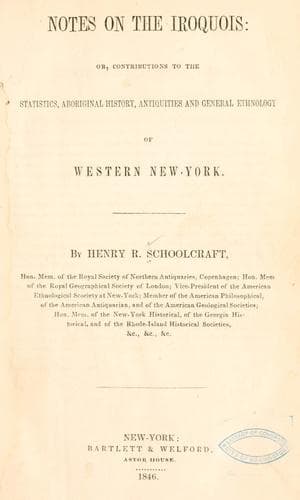
Notes on the Iroquois: or, Contributions to the Statistics, Aboriginal History, Antiquities and General Ethnology of Western New-YorkSchoolcraft, Henry Rowe
History
Notes on the Iroquois: or, Contributions to the Statistics, Aboriginal History, Antiquities and General Ethnology of Western New-York
Schoolcraft, Henry Rowe
Indians of North America -- New York (State); Iroquois Indians
In the course of the long and fierce war between the Six Nations and
the Cherokees, it happened, said Oliver Silverheels, that eight Senecas
determined to go on an embassy of peace. Among them was LITTLE
BEARD, the elder, and Jack Berry. They met some Cherokees on the
confines of the Cherokee territories, to whom they imparted their
object. Intelligence of this interview was sent forward to their
village, where the ambassadors were duly received, and after this
preliminary reception, they were introduced to the ruling chiefs, and
favorably received by the Cherokee council.
All but _one_ of the Cherokee chiefs agreed to the terms of peace. He
also would consent, if, prior to the treaty, the eight Seneca delegates
would first consent to go to war against their enemies, situated south
of them. [Who their enemies were is not mentioned.] They consented,
and set out with a war party. A fight ensued in which the leader of
the Senecas, called AWL, was taken prisoner. The other seven
escaped. The fate of Awl was decided in the enemies camp, where it
was determined that he should be burned at the stake. Preparations
were made for this purpose, but as they were about to bind him, he
claimed the privilege of a warrior, to sing his death song and recite
his exploits by striking the post. Pleased with the spirit of his
request, and his noble air and words, his suit was granted, and they
put a tomahawk into his hands, that he might go through the ceremony.
He began by relating his exploits in the north. He recited his feats
against the western Indians, adding, with the usual particularity,
times and places, and the number of scalps taken. They were pleased and
interested in these recitals, and quite forgot the prisoner, in the
warrior. At last he came to the late battle, in which he was taken. He
told how many of the Catabas, Apalaches, or Muscogees (if these were
the tribes) he had killed. He kindled with redoubled ardor as he struck
the post with his tomahawk, exclaiming, “so many of your own people, I
have killed,” and suiting his actions to his words, “so many I will yet
kill.” With this he struck down two men, bounded through the ring and
ran. Consternation, for a moment, prevented pursuit, which gave him a
start. Being swift of foot he outran his pursuers, eluded them in the
woods, and reached the Cherokee camp, where he found and joined his
seven companions.
They concluded the peace, and returned in safety to the Seneca country.
[_e._] The Graveyard Serpent and Corn Giant.
Seneca tradition states that they formerly lived on the Chippewa river,
near Niagara Falls, Canada. One year, while thus located, they were
visited by a calamitous sickness, and their corn was blighted. Their
prophet dreamt, one night, that a great serpent laid under the village,
with his head to the graveyard, and that it devoured all the bodies
buried. This gave a most offensive breath, which was the cause of the
sickness.
Public-domain text, read in full here on John Shaqi.
Reviews
Reviews
No reviews yet
Be the first to share your thoughts on this work.
Elsewhere in the archive
Join the Discussion
Join the discussion
Sign in to leave a comment or review.
Sign InorCreate an account