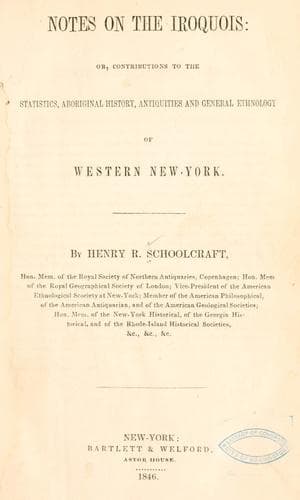
Notes on the Iroquois: or, Contributions to the Statistics, Aboriginal History, Antiquities and General Ethnology of Western New-YorkSchoolcraft, Henry Rowe
History
Notes on the Iroquois: or, Contributions to the Statistics, Aboriginal History, Antiquities and General Ethnology of Western New-York
Schoolcraft, Henry Rowe
Indians of North America -- New York (State); Iroquois Indians
By the figure of a long house, the Iroquois meant to denote the
confederated frame work of the league; by a great tree planted, they
symbolized its deep seated natural power, one in blood and lineage,
and its overshadowing influence and permanency. To assail such a
combination of stout hearts, nature they thought must send forth the
stoutest and most appalling objects of her creation.
The first enemy that appeared to question their power, or disturb their
peace, was the fearful phenomenon of Ko-nea-rau-neh-neh, or the Flying
Heads. These heads were enveloped in a beard and hair, flaming like
fire; they were of monstrous size, and shot through the air with the
velocity of meteors. Human power was not adequate to cope with them.
The priests pronounced them an emanation of some mysterious influence,
and it remained with the priests alone, to exorcise them by their arts.
Drum and rattle and incantation, were deemed more effective, than arrow
or club. One evening, after they had been plagued a long time with
this fearful visitation, the Flying Head came to the door of a lodge
occupied by a single female and her dog. She was sitting composedly
before the fire roasting acorns, which, as they become done, she
deliberately took from the fire and eat. Amazement seized the flying
head, who put out two huge black paws, from beneath his streaming
beard. Supposing the woman to be eating _live_ coals he withdrew, and
from that time he came no more among them.[86]
[86] For a poetic use of this tradition of the Heads and Stonish
Giants, see Hoffman’s Wild Scenes, vol. 1, page 82. New-York edition of
1843.
The withdrawal of the Ko-nea-rau-neh-neh, was followed by the
appearance of the great ONYARE,[87] or Lake Serpent, which
traversed the country, and by coiling himself in leading positions near
the paths, interrupted the communication between the towns. He created
terror wherever he went, and diffused a poisonous breath.
[87] Mohawk.
While this enemy yet remained in the land, and they were counselling
about the best means of killing him, or driving him away, the
country was invaded by a still more fearful enemy, namely: the
OT-NE-YAR-HEH, or Stonish Giants. They were a powerful tribe
from the wilderness, tall, fierce and hostile, and resistance to them
was vain. They defeated and overwhelmed an army which was sent out
against them, and put the whole country in fear. These giants were not
only of prodigious strength, but they were cannibals, devouring men,
women and children in their inroads.
Public-domain text, read in full here on John Shaqi.
Reviews
Reviews
No reviews yet
Be the first to share your thoughts on this work.
Elsewhere in the archive
Join the Discussion
Join the discussion
Sign in to leave a comment or review.
Sign InorCreate an account