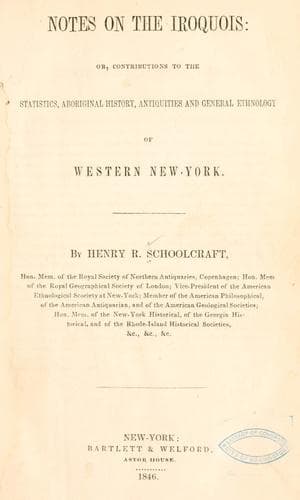
Notes on the Iroquois: or, Contributions to the Statistics, Aboriginal History, Antiquities and General Ethnology of Western New-YorkSchoolcraft, Henry Rowe
History
Notes on the Iroquois: or, Contributions to the Statistics, Aboriginal History, Antiquities and General Ethnology of Western New-York
Schoolcraft, Henry Rowe
Indians of North America -- New York (State); Iroquois Indians
No people in the world have ever, probably, so completely mingled
up and lost their early history, in fictions and allegories, types
and symbols, as the red men of this continent. Making no sort of
distinction themselves, between the symbolic and the historical, they
have left no distinctions to mark the true from the false. Their
notions of a Deity, founded, apparently, upon some dreamy tradition
of original truth, are so subtile and divisible, and establish so
heterogenous a connection, between spirit and matter, of all imaginable
forms, that popular belief seems to have wholly confounded the possible
with the impossible, the natural with the supernatural. Action, so
far as respects cause and effect, takes the widest and wildest range,
through the agency of good or evil influences, which are put in motion
alike for noble or ignoble ends—alike by men, beasts, devils or gods.
Seeing some things mysterious and wonderful, he believes all things
mysterious and wonderful; and he is afloat, without shore or compass,
on the wildest sea of superstition and necromancy. He sees a god in
every phenomenon and fears a sorcerer in every enemy. Life, under
such a system of polytheism and wild belief, is a constant scene of
fears and alarms. Fear is the predominating passion, and he is ready,
wherever he goes, to sacrifice at any altar, be the supposed deity
ever so grotesque. When such a man comes to narrate events, he stops
at nothing, be it ever so gross or puerile. He relates just what he
believes, and unluckily he believes every thing that can possibly be
told. A beast or a bird, or a man, or a god, or a devil, a stone, a
serpent, or a wizzard, a wind or a sound, or a ray of light—these are
so many causes of action, which the meanest and lowest of the series,
may put in motion, but which shall, in his theology and philosophy,
vibrate along the mysterious chain through the uppermost skies; and
life or death may, at any moment, be the reward or the penalty. If
there be truth, mingled in the man’s narrations, as there sometimes is,
it must be judged of by the lights of reason, common sense, science,
sound philosophy and religion. It is a gordian knot for the modern
historian to untie; or it is a mass of traditionary chaff, from which
we may, perhaps, winnow a few grains of wheat. Herodotus had, probably,
just such materials to work upon, and he made the best possible use
of them, by letting the events stand as they were given, without
exercising any inductive faculty upon them, or telling us the why and
the wherefore; or if he ever deviates from the rule, as in the case of
the fishes descending the Nile, it is a species of labor which might as
well have been omitted.[85]
[85] It was designed, when these preliminary remarks were penned, to
add some wilder legends than are here presented, which are, at present,
withheld.
Public-domain text, read in full here on John Shaqi.
Reviews
Reviews
No reviews yet
Be the first to share your thoughts on this work.
Elsewhere in the archive
Join the Discussion
Join the discussion
Sign in to leave a comment or review.
Sign InorCreate an account