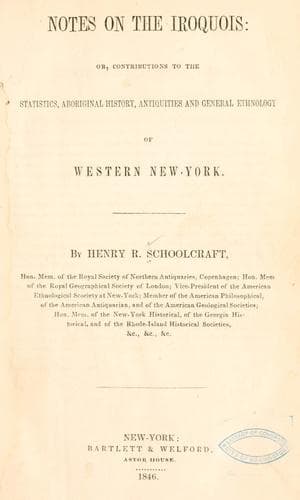
Notes on the Iroquois: or, Contributions to the Statistics, Aboriginal History, Antiquities and General Ethnology of Western New-YorkSchoolcraft, Henry Rowe
History
Notes on the Iroquois: or, Contributions to the Statistics, Aboriginal History, Antiquities and General Ethnology of Western New-York
Schoolcraft, Henry Rowe
Indians of North America -- New York (State); Iroquois Indians
Louis Hennepin, who was a Recollect, remarks in the original Amsterdam
edition of his travels of 1698, that Canada was first discovered by
the Spanish, alluding doubtless to the voyage of Corte-Real and that
it received its first missionaries under the French, from the order
of Recollects. These pioneers of the cross, according to this author,
made themselves very acceptable to the Hurons or Wyandots, who occupied
the banks of the St. Lawrence, and who informed them that the Iroquois
pushed their war parties beyond Virginia and New-Sweden, and other
parts remote from their cantons. They went, he says, in these wars,
near to a lake, which they called Erige or Erie.[88] Now, if they went
“beyond Virginia and New-Sweden,” they were very remote from Lake
Erie, and the assertion implies a contradiction or some ignorance of
the geography of the country. This name in the Huron language, he
informs us, signifies the Cat, or Nation of the Cat—a name, he says,
which it derived from the fact that the Iroquois in returning to their
cantons, brought the Erige or Erike, captives through it. The Canadians
softened this word to ERIE. It would appear then, that the
Eries either did not occupy the immediate banks of the lake, or else
they lived on the upper or more remote parts of it. To be brought
captives through it, they must have been embarked at some distance
from its lower extremity. This vague mode of expression leaves a doubt
as to the actual place of residence of this conquered and, so called,
extinct tribe. Whether extinct or not, is not certain. The name is only
a Wyandot name. They had others.
[88] Vide Appendix.
From inquiries made among the Senecas, they are, some believe, the same
people whom this nation call KAH-KWAHS. But we do not advance
much by changing one term for another. The inquiry returns, who were
the Kah-Kwahs? Seneca tradition affirms that they lived on the banks of
Lake Erie, extending eastward towards the Genesee river, and westward
indefinitely; and that they were finally conquered in a war, which was
closed by a disastrous battle, the locality of which is not fixed;
after which they were chased west, and the remnant driven down the
Allegheny river. [See the subsequent paper _d_.]
Cusick, the Tuscarora archæologist, who writes the word “Squawkihows,”
intimates that these were an affiliated people, and that the remnant
after their defeat, were incorporated with the Senecas. [D.]
Colden states that after the war with the Adirondacks broke out, say at
the end of the 16th century, the Iroquois, to try their courage, went
to war against a nation called Satanas,[89] who lived on the banks of
the lakes, whom they defeated and conquered, which raised their spirits
so much, that they afterwards renewed the war against the Adirondacks
and Hurons[90] on the St. Lawrence, and finally prevailed against them.
[Hist. Five Nations, p. 23, Lond. ed. 1767.]
Public-domain text, read in full here on John Shaqi.
Reviews
Reviews
No reviews yet
Be the first to share your thoughts on this work.
Elsewhere in the archive
Join the Discussion
Join the discussion
Sign in to leave a comment or review.
Sign InorCreate an account