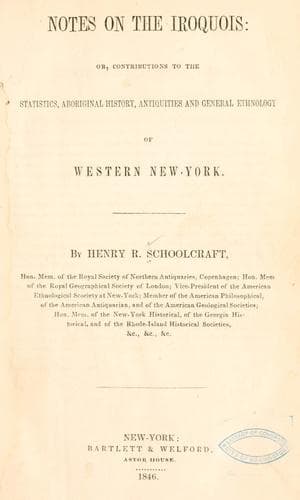
Notes on the Iroquois: or, Contributions to the Statistics, Aboriginal History, Antiquities and General Ethnology of Western New-YorkSchoolcraft, Henry Rowe
History
Notes on the Iroquois: or, Contributions to the Statistics, Aboriginal History, Antiquities and General Ethnology of Western New-York
Schoolcraft, Henry Rowe
Indians of North America -- New York (State); Iroquois Indians
[89] This word appears to be an English _soubriquet_, derived from the
Dutch language, and is from Satan, a synonyme for Duivel. [See Jansen’s
new Pocket Dictionary, Dortracht 1831.] The plural inflection in _a_,
if this derivation be correct, is duplicated in its meaning, by the
corresponding English inflection in _s_, a practice quite conformable
to English orthœpy, which puts its vernacular plural to foreign
plurals, as Cherubims for Cherubim, &c.
[90] Called Quatoghies by the Iroquois.
Satanas, it appears from the same author, is a name for the Shaouanons,
Shawanoes, or Shawnees, as the term is variously written; a tribe, it
may be further remarked, who are called _Chât_ by the modern Canadian
French.
A letter of the missionary Le Moyne, published in the Missionary
“Relacions,” and hereto appended, proves that the war with the Eries,
whatever may have been its origin or former state, had newly broken out
in 1653, and there are references of a subsequent date to denote that
by the year 1655, this war had terminated in the disastrous overthrow
of this people. They appear to have been then located where the
existing traditions of the Senecas place them, namely, west of Genesee
river, and at or near Buffalo. We may suppose that up to this period,
the Senecas were limited to the eastern banks of the Genesee. And it
was probably the results of this war that transferred their council
fire from the present site of Geneva or Canandaigua to the Genesee
valley.
When La Salle reached the Niagara river in 1679, but twenty-four years
after the close of this Erie war, he found the entire country on its
eastern or American banks in the possession of the Senecas. [J.] The
history and fate of the Eries was then a tradition.
We may here drop the inquiry to be resumed at a future period.
[_b._] Building of the first vessel on the upper lakes.
The enterprise of La Salle, in constructing a vessel above the falls
of Niagara, in 1679, to facilitate his voyage to the Illinois and the
Mississippi, is well known; but while the fact of his having thus been
the pioneer of naval architecture on the upper lakes, is familiar
to historical readers, the particular _place_ of its construction,
has been a matter of various opinions. Gen. Cass in his historical
discourse, places it at Erie; Mr. Bancroft in his history, designates
the mouth of the Tonawanda. Mr. Sparks in the biography of Marquette,
decides to place it on the Canadian side of the Niagara. These
variances result in a measure from the vague and jarring accounts of
the narrators, whose works had been consulted in some instances in
abridged or mutilated translations, and not from doubt or ambiguity in
the missionary “Letters.”
Public-domain text, read in full here on John Shaqi.
Reviews
Reviews
No reviews yet
Be the first to share your thoughts on this work.
Elsewhere in the archive
Join the Discussion
Join the discussion
Sign in to leave a comment or review.
Sign InorCreate an account