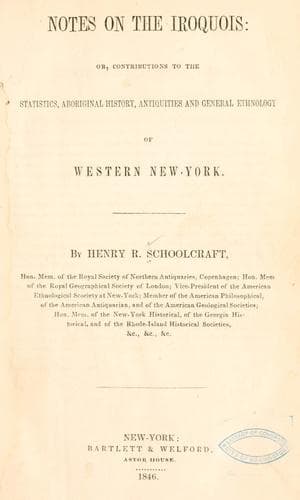
Notes on the Iroquois: or, Contributions to the Statistics, Aboriginal History, Antiquities and General Ethnology of Western New-YorkSchoolcraft, Henry Rowe
History
Notes on the Iroquois: or, Contributions to the Statistics, Aboriginal History, Antiquities and General Ethnology of Western New-York
Schoolcraft, Henry Rowe
Indians of North America -- New York (State); Iroquois Indians
Hennepin was the camp missionary of the party on the way to Illinois,
and the companion of La Salle and Tonti on the occasion. By adverting
to his narrative, in the appendix, the most satisfactory and
circumstantial details on this subject will be found. The vessel,
according to him, was built “two leagues above the falls,” that is,
about three miles above the present site of fort Schlosser, on Cayuga
creek. There is no stream, at this distance, on the Canadian side.
They reached the spot on the 22d of January, set up the keel on the
26th, and, after laboring all winter, amidst discouragements, during
which the Senecas threatened to burn it, at one time, and refused to
sell corn to support the workmen, at another, it was launched in the
spring, and named the Griffin, “in allusion to the arms of the Count
de Frontenac, which was supported by two griffins.” The figure of a
griffin adorned the prow, surmounted by an eagle, the symbolic type
of the embryo power, which was destined, in due time, to sway the
political destinies of the continent. There were seven small cannon,
and thirty persons, including the crew. With great difficulty, and by
the use of the _cordelle_, they ascended the rapids, the present site
of Black-Rock, and finally, after many delays, they set sail, freighted
with merchandize, on the 7th of August, 1679, just six months and
twelve days after they had laid the keel. Thus the honor of furnishing
the first vessel on our great chain of inland lakes, above the falls,
is due to the present area of Niagara county, New-York. How this
initiatory step has been followed up, in the course of one hundred and
sixty-seven years, until these lakes are whitened by the canvass of the
republic, and decorated with its self-moving palaces of wood and iron,
under the guise of steamboats, it would be interesting to note. But we
have no statistics of this kind to turn to. As an increment in such an
inquiry, I subjoin, in the appendix, lists kept at my office, in the
west, of the various species of vessels, which entered and departed
from the remote little harbor of Michilimackinac, during the sailing
seasons of 1839 and 1840, respectively.
[_c._] Who were the Alleghans?
Public-domain text, read in full here on John Shaqi.
Reviews
Reviews
No reviews yet
Be the first to share your thoughts on this work.
Elsewhere in the archive
Join the Discussion
Join the discussion
Sign in to leave a comment or review.
Sign InorCreate an account