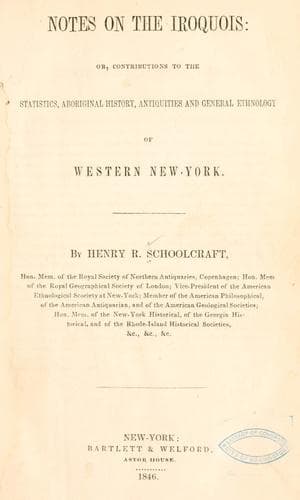
Notes on the Iroquois: or, Contributions to the Statistics, Aboriginal History, Antiquities and General Ethnology of Western New-YorkSchoolcraft, Henry Rowe
History
Notes on the Iroquois: or, Contributions to the Statistics, Aboriginal History, Antiquities and General Ethnology of Western New-York
Schoolcraft, Henry Rowe
Indians of North America -- New York (State); Iroquois Indians
This is an inquiry in our aboriginal archæology, which assumes a deeper
interest, the more it is discussed. All the republic is concerned
in the antiquarian knowledge and true etymology and history of an
ancient race, to whom tradition attaches valor and power, and who have
consecrated their name in American geography upon the most important
range of mountains between the valley of the Mississippi, and the
Atlantic. But the inquiry comes home to us with a local and redoubled
interest, from the fact, that they occupied a large portion of the
western area of the State, comprising the valley of the Alleghany river
to its utmost source, and extending eastwardly an undefined distance.
Even so late as 1727, Colden, in his history of the Five Nations,
places them under the name of “Alleghens,” on his map of this river.
It is not certain that they did not anciently, occupy the country as
far east and south as the junction of Allen’s creek, with the Genesee.
A series of old forts, anterior in age to the Iroquois power, extends
along the shores of lake Erie, up to the system of water communication
which has its outlet into the Alleghany through the Conewongo. There
are some striking points of identity between the character of these
antique military works, and those of the Ohio valley, and this
coincidence is still more complete in the remains of ancient art found
in the old Indian cemeteries, barrows and small mounds of western
New-York, extending even as far east as the ancient Osco, now Auburn.
The subject is one worthy of full examination, who this ancient race
were? whence they came? and whither they went? are inquiries fraught
with interest. We should not be led astray, or thrown off the track of
investigation by the name. All the tribes, ancient and modern, have
multiform names. This one of the Alleghans, probably fell upon the ears
of the first settlers, but it is far from certain that it was their own
term, while it is quite certain that it was not of the vocabulary of
the bold northern race, the Iroquois, who impinged upon them. It has
the character of an Algonquin word. Their descendants, whoever their
ancestors were, may yet exist, under their own proper name, in the far
west. The Iroquois, who pushed their conquests down the Alleghany and
Ohio rivers after them, did not found a claim to territory further
south on the Ohio river, than the mouth of the Kentucky. They pushed
their war parties to the Catawba and Cherokee territories across the
Alleghanies, and as far west as the Illinois. They swept over the whole
region included between lakes Ontario, Erie and Huron, north. In the
latter case we know it was a war against the tribes of the Algonquin
stock, including one branch of another, and that their own generic
stock, namely, the Quatoghies or Hurons.
Public-domain text, read in full here on John Shaqi.
Reviews
Reviews
No reviews yet
Be the first to share your thoughts on this work.
Elsewhere in the archive
Join the Discussion
Join the discussion
Sign in to leave a comment or review.
Sign InorCreate an account