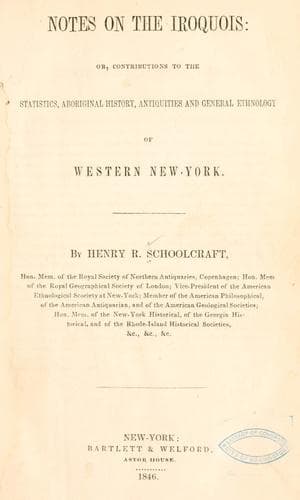
Notes on the Iroquois: or, Contributions to the Statistics, Aboriginal History, Antiquities and General Ethnology of Western New-YorkSchoolcraft, Henry Rowe
History
Notes on the Iroquois: or, Contributions to the Statistics, Aboriginal History, Antiquities and General Ethnology of Western New-York
Schoolcraft, Henry Rowe
Indians of North America -- New York (State); Iroquois Indians
Algonquin tradition, recorded by Mr. Heckewelder in the Am. Phi. Trans.
in 1819, on the part of the Lenapees, denotes that a confederation of
these two stocks, namely, the political uncles and nephews, defeated
the Alleghans, and drove them from the country. This tradition is
referred to a time when the Delawares or Lenapees, were shorn of all
power and consequence, “having been degraded,” according to their
phrase, to assume the petticoat, and found a refuge in a new country,
to them, on the Muskingum, where they were taken under the care,
as they had previously been east of the mountains, of the Moravian
brethren. In their reminiscences they would consequently be prone to
give prominence to such events as would reflect the most favorable
lights on their history. They are speaking of events which we see
by the preceding references, must have transpired 500 or 600 years
before, and in a very distant quarter of the Union. Yet they add some
particulars which written history alone could preserve; and they
ascribe to themselves such a degree of foresight, prudence, wisdom,
valor and sense of Christian justice, as no Indian tribe in America
ever evinced. These traditions are recorded by Mr. Heckewelder in
a spirit of Christian kindness on his part, but he does not vouch
for them; they are to be judged, like other traditions, by their
probabilities and their conformity to other and known traditions. It is
on this account that I have adduced the preceding data. Every Indian
nation is prone to exalt itself, and if we would admit fully the claims
of each, the rest would be sorry persons indeed.
The first thing to be borne in mind is, that the tradition is a very
ancient one, and must have come down shorn of many particulars, which
there appears to have been great carefulness to re-state. The scene
also is remote from the place of narration. No such fact as the
principal one of the crossing, on which great stress is laid by Mr.
Mayer, on the part of the Maryland Historical Society, could have taken
place in the Ohio valley, or within one thousand miles of Pittsburgh,
where alone, it must be remembered, we have any evidence in the
existing names of the country of the residence of the Alleghans.
Public-domain text, read in full here on John Shaqi.
Reviews
Reviews
No reviews yet
Be the first to share your thoughts on this work.
Elsewhere in the archive
Join the Discussion
Join the discussion
Sign in to leave a comment or review.
Sign InorCreate an account