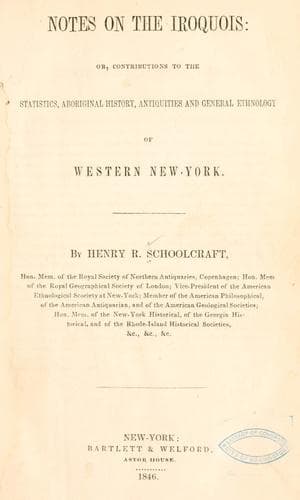
Notes on the Iroquois: or, Contributions to the Statistics, Aboriginal History, Antiquities and General Ethnology of Western New-YorkSchoolcraft, Henry Rowe
History
Notes on the Iroquois: or, Contributions to the Statistics, Aboriginal History, Antiquities and General Ethnology of Western New-York
Schoolcraft, Henry Rowe
Indians of North America -- New York (State); Iroquois Indians
Tradition, not of the highest character, gives us the words Talligeu,
or Talligwee, as the name of this ancient nation, although it is
nearly identical in sounds with the existing and true name of the
Cherokees, which, according to the late Elias Boudinot, (a Cherokee,)
is TSALLAKEE. Col. Gibson, a plain man, an Indian trader and
no philologist, who furnished Mr. Jefferson with Indian vocabularies
of the dialects of his day, to be used in answer to the inquiries
of Catherine the Great, (vide Trans. Royal Academy, Petersburgh,)
expressed an opinion that this ancient people did not use a T before
the epithet, but were called Allegewee. Tradition has, however,
strictly speaking, preserved neither of these terms, although both
appear to have strong affinities with them. The word Alleghany has
come down to us, from the earliest times, as the name of the great
right-hand fork of the Ohio, and also as the name, from the same remote
period of antiquity, of the chain of mountains of which the stream
itself may be said to be the most remote northeasterly tributary.
In this form it is evidently a local term, applied geographically,
according to the general principles of the Indian languages, like
_hanna_ in the Susquehanna, and _hannock_ in the Rappahannock, which
appear to denote, in each case, a river, or torrent of water. By
removing this local inflection, we have Alleghan as the proper term for
the people, and I have felt sustained, by this inductive process, in
regarding Alleghan as the original cognomen of the “_mound builders_”
of North America.
Having thus given my views with respect to the particular word which
awakened this discussion, permit me now to turn to the other matters,
so confidently brought forward by the secretary of the Maryland
Historical Society.
The Iroquois affirm that they formerly lived in the area of the
Cherokee country. (Clin. Dis. N. Y. H. Soc., vol.) Captain Smith met a
war party of this nation, in exploring one of the rivers of Virginia
in 1608. So late as the era of the settlement of North Carolina, they
brought off to the north the last of their cantons, in the tribe
of the Tuscaroras. They sold the lands as far south as Kentucky
river. (Imlay’s Hist. Kent.) They _quitclaimed_ the soil in northern
Virginia and Maryland, and they quite forbid all sales of land by the
Delawares. All authorities, indeed, concur in showing the track of
their migration, prior to 1600, to have been from the south to the
north and northeast. Affiliation of language is also thought to denote
their origin in the south. (Vide Gallatin, 2 vol. Archa. Amer.) The
Hurons, who are of the same stock, affirm that they were originally the
first of all the nations, and call the Lenapees, who have assumed the
same distinction, _nephews_, denoting inferiority in the chronological
and ethnological chain. In this term of nephews, so applied to the
Delawares, all the Iroquois tribes concur. (Vide Oneota.)
Public-domain text, read in full here on John Shaqi.
Reviews
Reviews
No reviews yet
Be the first to share your thoughts on this work.
Elsewhere in the archive
Join the Discussion
Join the discussion
Sign in to leave a comment or review.
Sign InorCreate an account