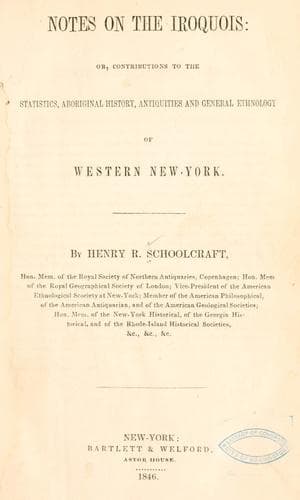
Notes on the Iroquois: or, Contributions to the Statistics, Aboriginal History, Antiquities and General Ethnology of Western New-YorkSchoolcraft, Henry Rowe
History
Notes on the Iroquois: or, Contributions to the Statistics, Aboriginal History, Antiquities and General Ethnology of Western New-York
Schoolcraft, Henry Rowe
Indians of North America -- New York (State); Iroquois Indians
The truth is, this suggestion of a peaceful passage for the great
Algonquin army, is to be found originally in the 20th chapter of
Numbers, in the demand made, by divine direction, by the Jewish leader
for a safe passport through the land of Edom, for the faithful
performance of which there was a divine guaranty. And when the kind
father had taught this historical lesson to his peaceable disciples on
the banks of the Muskingum, he did not perceive, in afterwards putting
down the traditions of his favorite Delawares, how completely they had
adapted a sacred event to the exigencies of savage life, in a host of
lawless invaders in the American wilderness, in the 12th century.
But we are not only to take this entire tradition of 1819, of an event
happening 600 years before, in extenso, with all its moral exactness of
motive, in the original actors, without any abatements or corrections
required by other traditions or history, but the good father, whose
moral excellence is pure and unimpeachable, but who was no philologist,
aims to make the existing lexicography of the Delaware _prove_ the
tradition; and we have, in a footnote, a forced etymology of the name
of the river Mississippi, to demonstrate that this is a Delaware name.
Now, the name of this river is not “Namaesa Sipu,” that is, sturgeon,
trout, or as he gives it, “fish river,” but MISSI-SIPPI—a
derivative from the adjective _great_, in an aboriginal sense, and
sippi, a river. Mr. Gallatin (Archa. Am. vol. 2) is inclined to believe
that it should be translated “the whole river,” or a unity of waters,
but neither he nor any other commentator, has been able to make
“fish” out of “missi.” The merest tyro in the Indian languages, must
perceive that the etymology does not bear the meaning of Fish river,
and if it did, it would prove, contrary to their reputation, that the
Indians give the most inappropriate geographical names, of all men in
existence. Fish river would be the most malappropriate name for the
Mississippi. Its turbid waters and rushing channel, surcharged with
floating trees, and subject to a thousand physical mutations every
season, is absolutely forbidding to the larger number of species, and
favorable only to the coarser kinds which are rejected from the table
of the epicure.
Public-domain text, read in full here on John Shaqi.
Reviews
Reviews
No reviews yet
Be the first to share your thoughts on this work.
Elsewhere in the archive
Join the Discussion
Join the discussion
Sign in to leave a comment or review.
Sign InorCreate an account