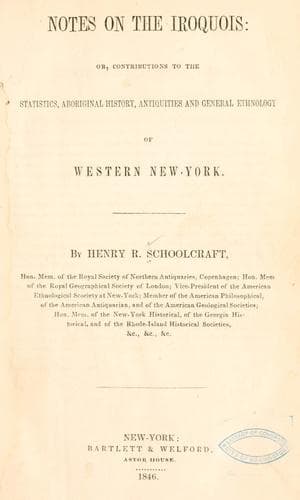
Notes on the Iroquois: or, Contributions to the Statistics, Aboriginal History, Antiquities and General Ethnology of Western New-YorkSchoolcraft, Henry Rowe
History
Notes on the Iroquois: or, Contributions to the Statistics, Aboriginal History, Antiquities and General Ethnology of Western New-York
Schoolcraft, Henry Rowe
Indians of North America -- New York (State); Iroquois Indians
A single remark more. The Delawares have never lived, or held an acre
of land on the Mississippi, in its whole course between Itasca lake
and the Balize. When Penn came to America, they lived on the Delaware,
in central Pennsylvania. They were ordered to quit the sources of
the Delaware river by the Iroquois in 1742, and go to Wyoming or
Shamoken.[95] They found their way across the Alleghanies, in time to
burn Col. Crawford at the stake,[96] and oppose the settlement of the
Ohio valley, prior to the revolution; they settled on the Muskingum,
and after some afflictions and mutations, chiefly brought upon
themselves, they accepted lands, and began to recross the Mississippi
in 1818[97]. They are now located on the west banks of the Missouri,
on the Konza. Yet the etymology adverted to attributes to this tribe,
not only the naming of the river upon which they never lived, and never
held any lands, but presupposes, that the Illinois and other Algonquin
nations living on its banks, above the influx of the Ohio and the
Missouri, to whom, with the influence of the French, the actual name is
due, preserved the Delaware term “Namæsa Sepu,” although it is neither
used by their descendants nor by Europeans.
[95] Colden’s Hist. Five Nations, vol. 1. p. 31.
[96] Metcalf’s Indian Wars in the West.
[97] This is the first time that this tribe ever by history, or
tradition, other than their own, saw this river.
[_d._] War with the Kah Kwahs.
Some inquiries have been made in a prior paper, on the strong
probabilities of this people, being identical with the Ererions or
Eries. While this question is one that appears to be within the grasp
of modern inquiry, and may be resumed at leisure, the war itself, with
the people whom _they_ call Kah-Kwahs, and _we_ Eries is a matter of
popular tradition, and is alluded to with so many details, that its
termination may be supposed to have been an event of not the most
ancient date. Some of these reminiscences having found their way into
the newspapers during the summer[98] in a shape and literary garniture,
which was suited to take them from the custody of sober tradition, and
transfer them to that of romance, there was the more interest attached
to the subject, which led me to take some pains to ascertain how
general or fresh their recollections of this war might be.
[98] See Buffalo Com. Adv. 12th July, 1845, article “Indian Tradition.”
Public-domain text, read in full here on John Shaqi.
Reviews
Reviews
No reviews yet
Be the first to share your thoughts on this work.
Elsewhere in the archive
Join the Discussion
Join the discussion
Sign in to leave a comment or review.
Sign InorCreate an account