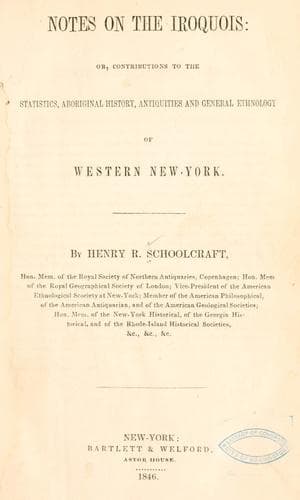
Notes on the Iroquois: or, Contributions to the Statistics, Aboriginal History, Antiquities and General Ethnology of Western New-YorkSchoolcraft, Henry Rowe
History
Notes on the Iroquois: or, Contributions to the Statistics, Aboriginal History, Antiquities and General Ethnology of Western New-York
Schoolcraft, Henry Rowe
Indians of North America -- New York (State); Iroquois Indians
Some time after this event, two Seneca hunters went out to hunt west
of the Genesee river, and as the custom is, built a hunting lodge of
boughs, where they rested at night. One day, one of them went out
alone, and having walked a long distance, was belated on his return.
He saw, as he cast his eye to a distant ridge, a large body of the
Kah-Kwahs marching in the direction of the Seneca towns. He ran to his
companion, and they instantly fled and alarmed the Senecas. They sent
off a messenger post-haste to inform their confederates towards the
east, and immediately prepared to meet their enemies. After about a
day’s march, they met them. It was near sunset when they descried their
camp, and they went and encamped in the vicinity. A conference ensued,
in which they settled the terms of the battle.
The next morning the Senecas advanced. Their order of battle was
this. They concealed their young men, who were called by the narrator
burnt-knives,[99] telling them to lie flat, and not rise and join the
battle until they received the war cry, and were ordered forward.
With these were left the rolls of peeled bark to tie their prisoners.
Having made this arrangement, the old warriors advanced, and began the
battle. The contest was fierce and long, and it varied much. Sometimes
they were driven back, or faltered in their line—again they advanced,
and again faltered. This waving of the lines to and fro, formed a
most striking feature in the battle for a long time. At length the
Senecas were driven back near to the point where the young men were
concealed. The latter were alarmed, and cried out “now, we are killed!”
At this moment, the Seneca leader gave the concerted war whoop, and
they arose and joined in battle. The effects of this reinforcement,
at the time that the enemy were fatigued with the day’s fight, were
instantaneously felt. The young Senecas pressed on their enemies with
resistless energy, and after receiving a shower of arrows beat down
their opponents with their war clubs, and took a great many prisoners.
The prisoners were immediately bound with their arms behind, and tied
to trees. Nothing could resist their impetuosity.
[99] A term to denote their being quite young, and used here as a cant
phrase for prime young warriors.
The Kah-Kwah chiefs determined to fly, and leave the Senecas masters of
the field. In this hard and disastrous battle, which was fought by the
Senecas alone, and without aid from their confederates, the Kah-Kwahs
lost a very great number of their men, in slain and prisoners. But
those who fled were not permitted to escape unpursued, and having been
reinforced from the east, they followed them and attacked them in their
residence on the Deoseowa (Buffalo creek) and Eighteen mile creek,
which they were obliged to abandon, and fly to the Ohio, [the Seneca
name for the Alleghany.].
Public-domain text, read in full here on John Shaqi.
Reviews
Reviews
No reviews yet
Be the first to share your thoughts on this work.
Elsewhere in the archive
Join the Discussion
Join the discussion
Sign in to leave a comment or review.
Sign InorCreate an account