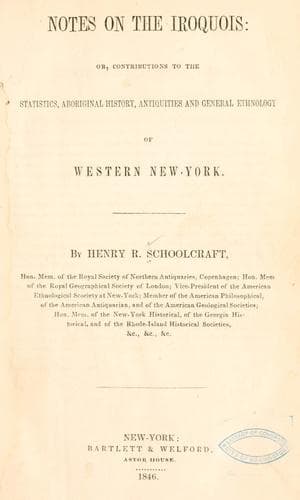
Notes on the Iroquois: or, Contributions to the Statistics, Aboriginal History, Antiquities and General Ethnology of Western New-YorkSchoolcraft, Henry Rowe
History
Notes on the Iroquois: or, Contributions to the Statistics, Aboriginal History, Antiquities and General Ethnology of Western New-York
Schoolcraft, Henry Rowe
Indians of North America -- New York (State); Iroquois Indians
The Senecas pursued them, in their canoes, in the descent of this
stream. They discovered their encampment on an island in numbers
superior to their own. To deceive them, the Senecas, on putting ashore,
carried their canoes across a narrow peninsula, by means of which they
again entered the river above. New parties appeared to the enemy, to be
thus continually arriving, and led them greatly to over-estimate their
numbers.
This was at the close of day. In the morning not an enemy was to be
seen. They had fled down the river and have never since appeared. It is
supposed they yet exist west of the Mississippi.[100]
[100] We may here venture to inquire, whether the Kah-Kwahs were not
a remnant, or at least allies of the ancient Alleghans, who gave name
to the river, and thus to the mountains. The French idea, that the
Eries were exterminated, is exploded by this tradition of Blacksnake,
at least if we concede that Erie and Kah-Kwah, were synonyms, which is
questionable. A people who were called Ererions by the Wyandots, and
Kah-Kwahs by the Iroquois, may have had many other names, from other
tribes. It would contradict all Indian history, if they had not as many
names as there were diverse nations, to whom they were known.
Two characteristic traits of boasting happened in the first great
battle above described. The Kah-Kwah women carried along, in the rear
of the warriors, packs of moccasins, for the women and children, whom
they expected to be made captives in the Seneca villages. The Senecas,
on the other hand, said, as they went out to battle, “let us not fight
them too near for fear of the stench”—alluding to the anticipated
heaps of slain.
[_22nd August_, 1845.]
IX. MISCELLANEOUS TRAITS.
A few traits are thrown in, under this head, in the shape of
anecdotes, which are thought to be illustrative of Indian
character.
[_a._] Infant Atotarho of the Onondaga.
Public-domain text, read in full here on John Shaqi.
Reviews
Reviews
No reviews yet
Be the first to share your thoughts on this work.
Elsewhere in the archive
Join the Discussion
Join the discussion
Sign in to leave a comment or review.
Sign InorCreate an account