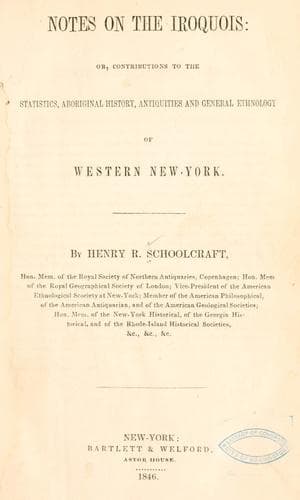
Notes on the Iroquois: or, Contributions to the Statistics, Aboriginal History, Antiquities and General Ethnology of Western New-YorkSchoolcraft, Henry Rowe
History
Notes on the Iroquois: or, Contributions to the Statistics, Aboriginal History, Antiquities and General Ethnology of Western New-York
Schoolcraft, Henry Rowe
Indians of North America -- New York (State); Iroquois Indians
I did not think to ask the name of this promising young candidate for
the seat and honors of the Atotarho, or chief magistracy of his nation.
His father’s name is TSO-HA-NEEH-SA, which, according to the
curious principles of naming persons, and the still more curious rules
of the Indian syntax, means a road, the receding parallel lines of
which intermingle by atmospheric refraction. This, apparently to them,
mysterious uniting and separating of the lines in such a vista, is the
idea described by this compound term. The boy, however, inherits, or
has the right of inheritance of the Atotarho, not “a king,” through the
mother, who was a daughter of the principal Ho-ai-ne, or chief. This
daughter was married to Ezekiel Webster, an American, a New-Englander,
a Vermonter, I think, who either by freak, taste or fortune, wandered
off among the Iroquois soon after the close of the American revolution,
and finally fixed himself in the Onondaga valley, where he learned the
language, established a trade in the gensing root, and became a man
of note and influence in the tribe. He died in old age, and is buried
in this valley, where he has left sons and daughters, all of whom,
however, are recognized as members of the ancient Onondaga canton, or
People of the Hills.
[_b._] Red Jacket and the Wyandot claim to supremacy.
At a great council of the western tribes, assembled near Detroit,
prior to the late war, the celebrated Seneca orator, Red Jacket, was
present, when the question of the right of the Wyandots to light the
council fire, was brought up. This claim he strenuously resisted, and
administered a rebuke to this nation in the following terms:
“Have the Quatoghies forgotten themselves? Or do they suppose we have
forgotten them? Who gave you the right in the west or east, to light
the general council fire? You must have fallen asleep, and dreamt
that the Six Nations were dead! Who permitted you to escape from the
lower country? Had you any heart left to speak a word for yourselves?
Remember how you hung on by the bushes. You had not even a place to
land on. You have not yet done p——g for fear of the Konoshioni. High
claim, indeed, for a tribe who had to run away from the Kadarakwa.[101]
[101] Hon. Albert H. Tracy.
“As for you, my nephews,” he continued, turning to the Lenapees, or
Delawares, “it is fit you should let another light your fire. Before
Miqùon came, we had put out your fire and poured water on it; it would
not burn. Could you hunt or plant without our leave? Could you sell
a foot of land? Did not the voice of the Long House cry, go, and you
went? Had you any power at all? Fit act indeed for you to give in to
our wandering brothers—you, from whom we took the war-club and put on
petticoats.[102]”
[102] For similar language to this, addressed to the Delawares, see
Colden’s Fire Nations, for a speech of an Iroquois chief, in council,
at Lancaster.
[_c._] Anecdote of Brant.
Public-domain text, read in full here on John Shaqi.
Reviews
Reviews
No reviews yet
Be the first to share your thoughts on this work.
Elsewhere in the archive
Join the Discussion
Join the discussion
Sign in to leave a comment or review.
Sign InorCreate an account