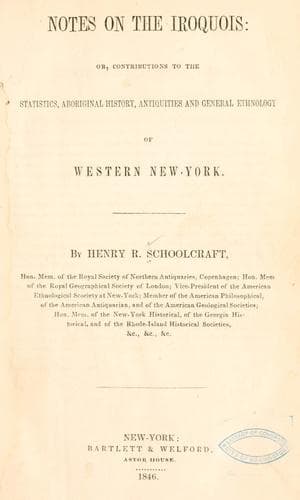
Notes on the Iroquois: or, Contributions to the Statistics, Aboriginal History, Antiquities and General Ethnology of Western New-YorkSchoolcraft, Henry Rowe
History
Notes on the Iroquois: or, Contributions to the Statistics, Aboriginal History, Antiquities and General Ethnology of Western New-York
Schoolcraft, Henry Rowe
Indians of North America -- New York (State); Iroquois Indians
When this chief was in London, he received ten pounds sterling, to be
given, on his return to America, to any person or persons, among his
people, whom he found to be doing most to help themselves. On coming
to the Seneca reservation on Buffalo Creek, they had just finished the
church, at an expense of seventeen hundred dollars. He gave the money
to these Indians to buy stoves to warm it, which are still used for
this purpose. He said he had seen no people who were doing so much to
help themselves.[103]
[103] Rev. A. Wright.
[_d._] The County Clerk and the wolf-scalp.
A Seneca hunter killed a wolf just within the bounds of Cattaraugus
county, close to the Pennsylvania line, and took the scalp to
Meadville, Pennsylvania, for the bounty. Being questioned where the
animal was killed, he honestly told the officer that he had come
across it and shot it, as near as he could tell, within the territory
of New-York, very near the state and county lines. On this, the clerk
told him that it would be contrary to law to pay him the bounty. “That
is a _bad_ law!” replied the red man. “Why?” said the magistrate—“we
cannot pay for scalps taken out of the county.” “It is bad,” replied
the hunter, “because you require that the wolf should know the county
lines. Had this wolf seen a flock of sheep just within the Pennsylvania
lines, I dare say he would not have stopped for the county lines.” On
this, the magistrate paid him the bounty of five dollars.[104]
[104] N. T. Strong, Esq.
X. MORAL AND SOCIAL CONDITION AND PROSPECTS.
The gospel was preached to the Iroquois as well as to the several
tribes of Algonquin origin, who lined the banks of the Hudson and the
Delaware, early in the 17th century. The Reformed Church of Holland
does not appear to have underrated its duties in this respect, while
the Holland States, under a hereditary President or Stadtholder, were
extending their civil jurisdiction and commercial enterprise on this
continent, notwithstanding the want of any direct evidence, that the
conversion of the Indians constituted a fixed part of the policy of the
servants and governors of the West India Company, to whose lot it fell
to introduce the arts and commerce of the mother country. It was the
common impression of those times, not only in Holland, the centre of
theological discussion, but in the reformed churches generally, that
civilization and the arts must precede the introduction of Christianity
among barbarous and idolatrous nations, and it was under such views,
that the gospel was first carried to India and to Iceland by the pious
zeal of the German reformers.
Public-domain text, read in full here on John Shaqi.
Reviews
Reviews
No reviews yet
Be the first to share your thoughts on this work.
Elsewhere in the archive
Join the Discussion
Join the discussion
Sign in to leave a comment or review.
Sign InorCreate an account