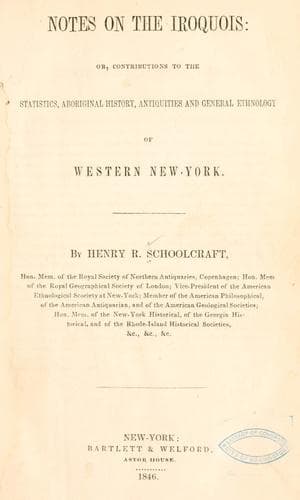
Notes on the Iroquois: or, Contributions to the Statistics, Aboriginal History, Antiquities and General Ethnology of Western New-YorkSchoolcraft, Henry Rowe
History
Notes on the Iroquois: or, Contributions to the Statistics, Aboriginal History, Antiquities and General Ethnology of Western New-York
Schoolcraft, Henry Rowe
Indians of North America -- New York (State); Iroquois Indians
This much can be said, without disparagement to the piety of the
Netherland church, which had her pastors and teachers at Manhattan,
Fort Orange, and various other incipient points of her settlements
at an early day. Whatever had been her policy, (and we have paid but
little attention to this,) in sending teachers among the Mohegans, the
Maquaas and other tribes who resorted to her forts and factories at
Albany, and other points of early contact with these simple and warlike
men; the English, after the conquest of 1664, appear to have followed
in her footsteps, and pursued the same general, gradual and persuasive
means, attaching high and deserved value at all points to the influence
of European arts and the value of fixed industry.
Churches were founded at an early day, among the Mohawks at Caghnawaga,
and at Dionderoga at the mouth of Schoharie Creek, better known as Fort
Hunter, the latter of which received a present of a set of plate for
the communion service, from Queen Ann.
Unfortunately for the conversion and civilization of the Indians,
they had not a fixed population—they drew their supplies mainly
from the chase, gave up a large portion of their time and means to
war, and besides moving periodically, at least twice a year, _from_
or _to_ their hunting and planting grounds, they were in a general
progress of recession before a civilized population. They shrank before
the determined spirit of progress of civilized arts and industry,
which elicited resources where the Indian had seen none, and made an
industrious use of every acre of tillable ground. But while the silent
influence of this progress did much to teach him, by denoting the
use of tools and implements of art and agriculture, to improve him
in his domicil and its fixtures, and his costume, and to harmonize
and fix his mental habits and character, he was not proof against
the leading temptation of the times, namely, the free and inordinate
use of ardent spirits. From the partial paroxysms of this pernicious
indulgence, he rose with less energy to pursue the chase, or follow
the war path. The policy of land sales, the distribution of presents
as boons from the crown, and the distribution of small sums of coin to
the heads of families in the shape of annuities. A system founded in
all but the last feature, under James VI, and confirmed under the old
confederation, stepped in, as it were, to aid and reinforce him in his
means of living, but which in effect, held him away from his hunting
grounds, paralyzed his home industry, and supplied him new means of
indulging his propensities for liquor and luxuries. That the gospel
should not have made a very marked progress under these circumstances,
is not surprising.
Public-domain text, read in full here on John Shaqi.
Reviews
Reviews
No reviews yet
Be the first to share your thoughts on this work.
Elsewhere in the archive
Join the Discussion
Join the discussion
Sign in to leave a comment or review.
Sign InorCreate an account