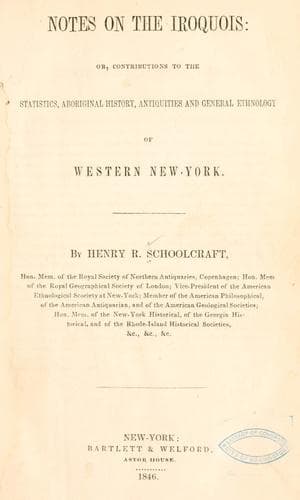
Notes on the Iroquois: or, Contributions to the Statistics, Aboriginal History, Antiquities and General Ethnology of Western New-YorkSchoolcraft, Henry Rowe
History
Notes on the Iroquois: or, Contributions to the Statistics, Aboriginal History, Antiquities and General Ethnology of Western New-York
Schoolcraft, Henry Rowe
Indians of North America -- New York (State); Iroquois Indians
Some years before the breaking out of the American revolution, Mr.
Kirkland planted the gospel standard among the Oneidas, at a time when
the broad and sylvan fields and glades of Kun-a-wa-loa, or Oneida
Castle, were still beyond the pale of European civilization.[105] And
he is to be regarded as the apostle to the Iroquois. For many years,
in perils and dangers, he preached the gospel to the Oneidas, at their
once celebrated castle; and by the purity, firmness and excellence
of his character, won the confidence and the heart of their leading
sachem. Skenandoah, gave his attention to this new scheme of acceptance
with his Maker, admitted it, and became a consistent professor and
practicer of its precepts, and of him, it can be confidently said,
that he lived and died in the faith. To gain the influence of the most
powerful man in the canton, was to gain the whole canton; and when the
war broke out, the tribe, wavering, as it did for a time, and assailed
with all the arts of British intrigue and promise, so profusely put
forth, adhered to the colonies. Kirkland, in the inception and progress
of these movements, became the principal agent in disseminating the
doctrines of peace and neutrality among the six cantons. Washington
and the continental congress, reposed the highest trust in his virtue,
judgment, and intelligence. He took from the lips of the father of his
country, words of peace and good counsel, which coincided admirably,
with the precepts of the gospel. He traversed the then wilderness of
Genesee and Niagara on this mission, and has left enduring monuments of
his faithfulness and zeal.
[105] Herkimer, the nearest point east, was about 40 miles distant.
But the spirit of war prevailed—that spirit which the great body
this people had so long served, under the guidance of their native
priesthood. All but the Oneidas, some few of the Tuscaroras, who
were then settled in their western precincts, and some one or two
individuals, from St. Regis, joined the ranks of the mother country,
under their bold and politic leader Brant. Seven years of battles,
expeditions, ambushes, and murders, terminated not only in their
political overthrow as a confederacy, but plunged many of them who
had before listened to the voice of Christianity, back into the arms
of their native priests and forest habits. The Mohawks, part of the
Cayugas, and some Onondagas and Tuscaroras, fled the country, and
settled chiefly in Canada. The Oneidas, the body of the Onondagas
and Senecas, and some parts of the Cayugas and Tuscaroras, remained.
But they had fought for a phantom. All the rich promises of glory
and conquest, emanating from Johnson Hall and fort Niagara, and the
Canadas had failed; and their delegates came to the treaty of Fort
Stanwix in 1784, poor, crest fallen, and defeated. And by their first
public act, after the drama of the revolution, they put their hands to
a treaty, ceding away the larger portion of their ancient domain.
Public-domain text, read in full here on John Shaqi.
Notes on the Iroquois: or, Contributions to the Statistics, Aboriginal History, Antiquities and General Ethnology of Western New-York — John Shaqi
Reviews
Reviews
No reviews yet
Be the first to share your thoughts on this work.
Elsewhere in the archive
Join the Discussion
Join the discussion
Sign in to leave a comment or review.
Sign InorCreate an account