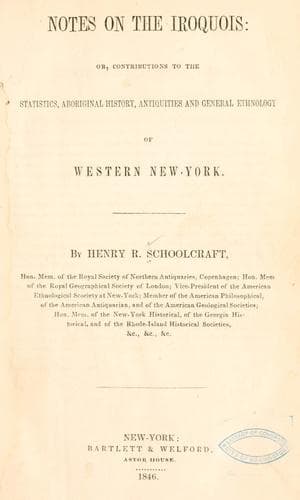
Notes on the Iroquois: or, Contributions to the Statistics, Aboriginal History, Antiquities and General Ethnology of Western New-YorkSchoolcraft, Henry Rowe
History
Notes on the Iroquois: or, Contributions to the Statistics, Aboriginal History, Antiquities and General Ethnology of Western New-York
Schoolcraft, Henry Rowe
Indians of North America -- New York (State); Iroquois Indians
Otsego, he adds, is from Ot, water, and Sago, hail, welcome, how d’ye
do? This I don’t believe. It is not in accordance with the Indian
principles of combination.
ONEIDA LANGUAGE.
The Oneidas call a man, Lon gwee.
“ a woman, Yon gwee.
“ God, Lonee.
“ Evil Spirit, Kluneolux.
Some of their words are very musical, as Ostia, a bone; ahta, a shoe;
kiowilla, an arrow; awiali, a heart; loainil, a supreme ruler.
The French priests, who filled the orthography of this language with
the letter R, committed one of the greatest blunders. There is no sound
of R, in the language; by this letter, they constantly represent the
sound of L.
ONEIDA CASTLE, _July_.
In a conference with Abraham Denne, an aged Oneida, he stated that
Brandt was brought up by his (Denne’s) grandfather, at Canajoharie;
that he was a bastard, his mother Mohawk, and did not come of a line of
chiefs. Says, that Scanado was a Tory in the war, notwithstanding his
high name; that he acted against us at the siege of Fort Stanwix. The
anecdote of an Indian firing from a tree, he places, while they were
repairing the fort; says that after the man got up, he drew up loaded
rifles with a cord; that both Scanado and Brant were present.
Says Scanado was adopted by the nation, when quite young; came from the
west; does not know of what tribe, but showed himself smart, and rose
to the chieftaincy by his bravery and conduct. Says, that the (syenite)
stone on the hill, is the true Oneida stone, and not the white stone
at the spring; was so pronounced by Moses Schuyler, son of Hon Yost,
who knew it forty years ago; that the elevation gave a view of the
whole valley, so that they could descry their enemies at a distance
by the smoke of their fires; no smoke, he said, without fire. They
could notify also, from this elevation, by a beacon fire. The name of
the stone is O-ne-a-ta; auk, added, renders it personal, and means an
Oneida. The word Oneida is an English corruption of the Indian.
ORIGIN OF THE ONEIDAS.
Abraham Schuyler, an Oneida, says that the Oneidas originated in two
men, who separated themselves from the Onondagas. They first dwelt at
the outlet of Oneida lake. Next removed to the outlet of Oneida creek,
on the lake, where they fortified. Williams says he was born there, and
is well acquainted with the old fort. They then went to the head of the
valley at the Oneida stone, from which they were named. Their fourth
remove was to the present site of Oneida Castle, called a skull on a
pole, where they lived at the time of the discovery of the country and
settlement of the colony by the Dutch, (i. e. 1609 to ’14.)
_Site of the Oneida Stone, Stockbridge._
ETYMOLOGY.
Asked several Oneidas to pronounce the name for the Oneida stone. They
gave it as follows:
O-ni-o-ta-aug.
O-ne-u-ta-aug.
O-ne-yo-ta-aug.
Public-domain text, read in full here on John Shaqi.
Reviews
Reviews
No reviews yet
Be the first to share your thoughts on this work.
Elsewhere in the archive
Join the Discussion
Join the discussion
Sign in to leave a comment or review.
Sign InorCreate an account