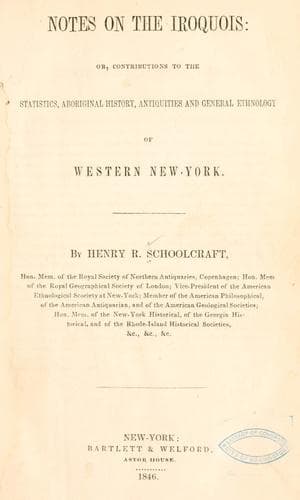
Notes on the Iroquois: or, Contributions to the Statistics, Aboriginal History, Antiquities and General Ethnology of Western New-YorkSchoolcraft, Henry Rowe
History
Notes on the Iroquois: or, Contributions to the Statistics, Aboriginal History, Antiquities and General Ethnology of Western New-York
Schoolcraft, Henry Rowe
Indians of North America -- New York (State); Iroquois Indians
The terminal syllable, _aug_, seems to be a local particle, but carries
also with its antecedent _ta_, the idea of life or existence, people or
inhabitants.
Onia is a stone. The meaning clearly is, People of the (or who have
sprung from the) Place of the _Stone_.
Adirondack, Jourdain, pronounces Lod-a-lon-dak, putting l’s for r’s and
a’s. It means a people who eat trees—an expression ironically used for
those who eat bark of trees.
For Cherokees, he gives We-au-dah.
For Delawares, Lu-na-to-gun.
What a mass of fog philologists are fighting with, who mistake, as
the eminent Vater and Adelung have, in some cases done, the different
_names_ of the same tribes of American Indians for different _tribes_.
* * * * *
ANTIQUE CORN HILLS.
Counted one hundred cortical layers in a black walnut—centre broke so
as to prevent counting the whole number, but by measuring estimated one
hundred and forty more. If so, the field was deserted in 1605.
The present proprietor of the farm comprising the Oneida stone, spring,
butternut grove, &c. is Job Francis. He first hired the land of
Hendrick’s widow; afterwards he and Gregg were confirmed by the State.
The white stone at the spring, a carbonate of lime, is not the _true_
Oneida stone.
The Oneida stone is a _syenite_—a boulder.
ONONDAGA CASTLE.
Abraham Le Fort says, that Ondiaka was the great chronicler of his
tribe. He had often heard him speak of the traditions of his father.
On his last journey to Oneida he accompanied him. As they passed south
by Jamesville and Pompey, Ondiaka told him that in ancient times, and
before they fixed down at Onondaga, they lived at these spots. That it
was before the Five Nations had confederated; but while they kept up a
separate existence, and fought with each other. They kept fighting and
moving their villages often. This reduced their numbers, and kept them
poor and in fear. When they had experienced much sickness in a place,
they thought it best to quit it and seek some new spot where it was
hoped they should have better luck. At length they confederated, and
then the fortifications were no longer necessary, and fell into disuse.
This is the origin, he believes, of these old works, which are not of
foreign origin.
Ondiaka told Le Fort that the Onondagas were created by Ha-wä-ne-o,
in the country where they lived. That he made this entire “island”
HA-WHO-NAO, for the red race, and meant it for them alone. He
did not allude to, or acknowledge any migrations from foreign lands.
Public-domain text, read in full here on John Shaqi.
Reviews
Reviews
No reviews yet
Be the first to share your thoughts on this work.
Elsewhere in the archive
Join the Discussion
Join the discussion
Sign in to leave a comment or review.
Sign InorCreate an account