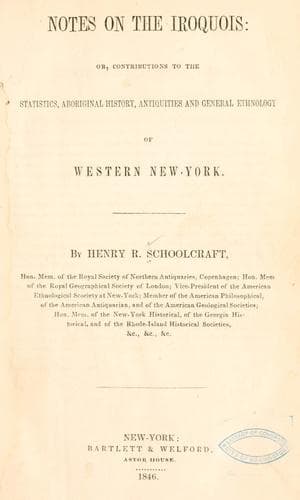
Notes on the Iroquois: or, Contributions to the Statistics, Aboriginal History, Antiquities and General Ethnology of Western New-YorkSchoolcraft, Henry Rowe
History
Notes on the Iroquois: or, Contributions to the Statistics, Aboriginal History, Antiquities and General Ethnology of Western New-York
Schoolcraft, Henry Rowe
Indians of North America -- New York (State); Iroquois Indians
Mr. I. Keeler says that he cut a large oak tree, near the site of
the old fort, two and a half feet through. In re-cutting it, at his
door, a bullet was found, covered by 143 cortical layers. It was still
some distance to the centre. If this tree was cut in 1810, the bullet
was fired in 1667. Consult “Paris Documents,” 1666, treaty with the
Onondaga Iroquois.
The Goulds say that the fort was a square, with bastions, and had
streets within it. It was set round with cedar pickets, which had been
burnt down to the ground. Stumps of them were found by the plough.
Nearly every article belonging to the iron tools of a blacksmith shop
have been ploughed up at various times—an anvil, horn, vice screw,
&c.; Indian axes, a horse shoe, hinges, the strap hinge. A pair of
these hangs the wicket gate to his house.
A radius of five to six miles around the old fort would cover all
the striking remains of ancient occupancy in the towns of De Witt,
Lafayette and Pompey.
Webster told the Goulds that the French who occupied this fort, and had
the nucleus of a colony around it, excited the jealousy and ire of the
Onondagas by the hostility of some western tribes in their influence.
Against these the Onondaga warriors marched. The French then attacked
the red men, &c. This led to their expulsion and massacre. All were
killed but a priest who lived between the present towns of Salina and
Liverpool. He refused to quit peaceably. They then put a chain around a
ploughshare, and heating it, hung it about his neck; he was thus, with
the symbol of agriculture, tortured to death. His hut was standing when
the county was settled.
The attempt to settle western New-York by the French was in the age of
chivalry, (the 16th century,) and was truly Quixotic.
TRADITION.
Pompey and its precincts were regarded by the Indians as the ground of
blood, and it brought up to their minds many dark reminiscences, as
they passed it. Some twenty years ago, there lived an aged Onondaga,
who said that many moons before his father’s days, there came a party
of white men from the east in search of silver. From the heights of
the Onondaga hills, they descried the white foam of Onondaga lake, and
this was all the semblance they ever found of silver. One of the men
died, and was buried on Pompey hill, and his grave was marked by a
stone.[109] The others built a fort on the noted ground, about a mile
east of Jamesville, where they cultivated the land; but at length the
Indians came in the night, and put them all to death. But there was a
fearful and bloody strife, in which the Indians fell like leaves before
the autumn wind. This spot is the field of blood.
[109] QUERY.—Is not this the inscription stone now deposited
in the Albany Academy?
_L. Birdseye._
AURORA: August. See Rev. Mr. Mattoon.
Vestiges of the Cayugas—villages—orchards—old forts. Get a
vocabulary of their language from Canada. Get diagram of forts.
Public-domain text, read in full here on John Shaqi.
Reviews
Reviews
No reviews yet
Be the first to share your thoughts on this work.
Elsewhere in the archive
Join the Discussion
Join the discussion
Sign in to leave a comment or review.
Sign InorCreate an account