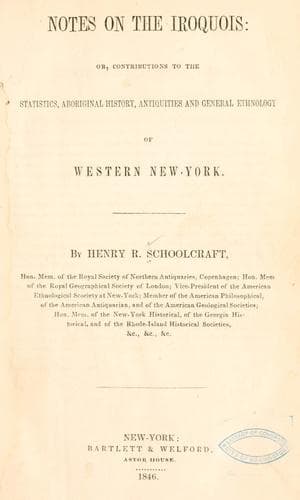
Notes on the Iroquois: or, Contributions to the Statistics, Aboriginal History, Antiquities and General Ethnology of Western New-YorkSchoolcraft, Henry Rowe
History
Notes on the Iroquois: or, Contributions to the Statistics, Aboriginal History, Antiquities and General Ethnology of Western New-York
Schoolcraft, Henry Rowe
Indians of North America -- New York (State); Iroquois Indians
Nothing is more distinct or better settled in the existing traditions
of the Iroquois, than their wars with the Cherokees. I found this
alluded to at Oneida, Onondaga, &c., in the course of their traditions,
but have not been able to trace _a cause_ for the war. They seemed
to have been deeply and mutually exasperated by perfidy and horrid
treachery in the course of these wars, such as the breaking of a peace
pledge, and murder of deputies, &c. Their great object was, as soon as
young men grew up, to go war against the Cherokees. This long journey
was performed without provisions, or any other preparation than bows,
clubs, spears and arrows. They relied on the forest for food. Thousands
of miles were not sufficient to dampen their ardor, and no time could
blot out their hatred. The Oneidas call them _We au dah_.
Jeremiah Gould went with me to view the twin mounds. They exhibit
numerous pits or holes, which made me at once think of the Assenjigun,
or hiding pit of the western Indians. Gould, in answer to my inquiry,
said that it was a tradition which he did not know how much value it
was worth, that the Tuscaroras were brought from the south by the
Oneidas, and first settled in this county. They warred against the
Onondagas. The latter, to save their corn, buried it in these mounds or
hills, then hid by the forest. In one of these excavations, dug into
forty years ago, they found a human skull and other bones belonging to
the human frame.
James Gould went with me over the stream (Butternut) to show me a
mound. It is apparently of geological formation, and not artificial.
Its sides were covered with large trees, the stumps of which remain.
There was a level space at the top, some four or five paces in
diameter, trees and bushes around. The apex, as paced, measures one
way 17, the other 12 paces; is elongated. It seemed to have been the
site of the prophet’s lodge. Near it is the old burying ground, on an
elongated ridge, where the graves were ranged in lines.
* * * * *
_Pottery._—Webster gives the Indian tradition of this ancient art
thus. The women made the kettles. They took clay and tempered it with
some siliceous or coarse stone. This they first burnt thoroughly, so as
to make it friable, (probably they plunged it while hot into water,)
and then pounded it, and mixed it with blood.
* * * * *
_Charred corn, &c._—In Ellisburgh is found much charred corn beneath
the soil, and numerous remains of occupancy by the natives. Is this the
evidence of Col. Van Schaack’s expedition into the Onondaga country
during the revolutionary war? His battle with the Indians, tradition
here says, took place near Syracuse. Bones, supposed to be of this era,
were discovered, in ditching the swamp near Cortland House.
KASONDA.
Public-domain text, read in full here on John Shaqi.
Reviews
Reviews
No reviews yet
Be the first to share your thoughts on this work.
Elsewhere in the archive
Join the Discussion
Join the discussion
Sign in to leave a comment or review.
Sign InorCreate an account