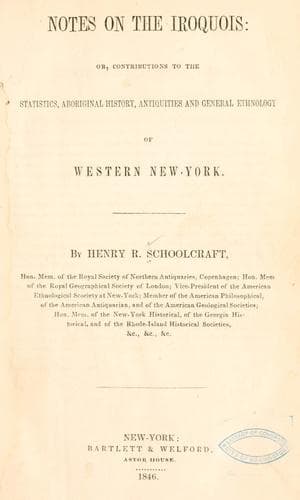
Notes on the Iroquois: or, Contributions to the Statistics, Aboriginal History, Antiquities and General Ethnology of Western New-YorkSchoolcraft, Henry Rowe
History
Notes on the Iroquois: or, Contributions to the Statistics, Aboriginal History, Antiquities and General Ethnology of Western New-York
Schoolcraft, Henry Rowe
Indians of North America -- New York (State); Iroquois Indians
1. Rent of land from twelve shillings to three dollars per acre.
2. Sale of timber, fire wood, hemlock bark, staves, saw-logs.
3. Fishing and hunting. Very little now.
4. Raise corn, cattle, horses, hogs, some wheat, &c. &c., cut hay.
Young men hire themselves out in harvest time.
BONES.
At Barnegat is an ancient ridge, or narrow raised path, leading from
the river some miles, through low grounds; it is an ancient burial
ground, on an island, in a swamp.
Bones of the human frame, bone needles, and other ancient remains, are
ploughed up at an ancient station, fort or line, in Shelby.
A human head, petrified, was ploughed up by Carrington, sen., in a
field in Alabama, Genesee county, and is now in the possession of Mr.
Grant, at Barnegat.
Petrified tortoises are said to be ploughed up in many places.
OPINION OF A CHIEF OF THE WORD SENECA.
De-o-ne-ho-ga-wa is the most influential chief of the Tonewandas. He
is of the Wolf tribe—born on the forks of the Tonewanda, and is 59
years old. Being interrogated as to the Seneca history, he says, that
the tradition of the tribe is clear—that they lived on the banks of
the Seneca and Canandaigua lakes. They were called Nun-do-wau-onuh, or
People of the Hill, from an eminence now called Fort Hill, at the head
of Canandaigua lake. They are now called, or, rather, call themselves,
Nun-do-wau-gau. The inflection onuh, in former times, denoted
residence, at a hill; the particle agau, in the latter, is a more
enlarged term for locality, corresponding to their present dispersed
condition.
The word Seneca, he affirms, is not of Indian origin. While they lived
in Ontario, there was a white man called Seneca, who lived on the banks
of the lake of that name. Who he was, where he came from, and to what
nation he belonged, he does not know. But wherever he originated, he
was noted for his bravery, wisdom and strength. He became so proverbial
for these noble qualities, that it was usual to say of such, and such a
one, among themselves, he is as brave as Seneca, as wise as Seneca, as
noble as Seneca. Whether the lake was called after him, or he took his
name from the lake, is not known. But the name itself is of European
origin. The tribe were eventually called Senecas from their local
residence. The idea, he says, was pleasing to them, for they thought
themselves the most brave and indomitable of men. Of all the races
of the Ongwe-Hon-we, they esteemed themselves the most superior in
courage, endurance and enterprize.
He refers to Te-to-yoah of Cattaraugus for further information.
On reference to Te-to-yoah, some time afterwards, he had no tradition
on this particular subject. The probability is, that Blacksmith meant
only to say, that the name was not Seneca. So far is true. What he says
of a great man living on Seneca lake, &c., in older times, is probably
a reproduction, in his mind, of an account of Seneca, the moralist,
which has been told him, or some Indian from whom he had it, in days
by-gone.
Public-domain text, read in full here on John Shaqi.
Reviews
Reviews
No reviews yet
Be the first to share your thoughts on this work.
Elsewhere in the archive
Join the Discussion
Join the discussion
Sign in to leave a comment or review.
Sign InorCreate an account