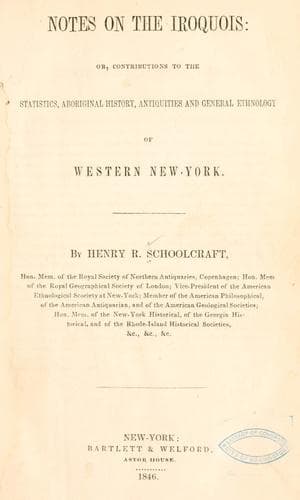
Notes on the Iroquois: or, Contributions to the Statistics, Aboriginal History, Antiquities and General Ethnology of Western New-YorkSchoolcraft, Henry Rowe
History
Notes on the Iroquois: or, Contributions to the Statistics, Aboriginal History, Antiquities and General Ethnology of Western New-York
Schoolcraft, Henry Rowe
Indians of North America -- New York (State); Iroquois Indians
As the name of Seneca is one of the earliest we hear, after 1609, it
was probably a Mohawk term for that people. It is spelt with a _k_ in
old French authors.
LEWISTON. [Frontier House.]
The Tuscarora clans are the following:
The Turtle.
The Wolf.
The Bear.
The Beaver.
The Snipe, or Plover.
The Eel. This is not an Iroquois totem.
The Land Tortoise.
They have lost the Falcon, Deer and Crane, perhaps in their
disastrous wars of 1713. By this it appears they have lost one clan
entirely—probably in their defeat on the Taw river, in N. Carolina.
Two others of the clans are changed, namely, the Falcon and Deer, for
which they have substituted the Land Tortoise and Eel.
Descent is by the chief’s mother and her clan, her daughter or nearest
kin, to be settled in council. The adoption of chiefs was allowed,
where there was failure of descent.
Curious barrow, or mound, on Dr. Scovill’s place—to be examined. Two
others, near the old mill and orchard.
Old fort of KIENUKA, to be visited.
Get vocabulary of Tuscarora, to compare.
This tribe has gone through a severe ordeal, their history is full of
incident. The following list shews their number in North Carolina, and
all other Indians of that colony in 1708.
Tuscaroras, living in 15 towns, 1,200 men.
Waccons, in 2 towns, 120
Maramiskeets, 30
Bear Rivers, 50
Hatteras, 16
Neuse, in 2 towns, 15
Pamlico, 15
Meherrin, 50
Chowan, 15
Paspatank, 10
Poteskeets of Carrituk, 30
Nottoways, 30
Connamox, in 2 towns, 25
Jaupim, 2
——-
1,608
=====
Visited James Cusick, the brother of DAVID, the Indian
archæologist, preacher to the Tusks, pictures in the house, old deeds
from Carolina.
Sunday. Attended Mr. Rockwood’s meeting, admirable behavior of all,
dress well, good singing. W. Chew interprets.
Females, however, adhere to their ancient costume.
Women more pertinacious in their social habits and customs than men.
Tuscaroras raise much wheat, cattle, horses, quite in advance of the
other tribes in agriculture.
They own the fee simple of about 5,000 acres, besides their
reservation, which they purchased from the Holland Company.
NIAGARA FALLS.
This name is Mohawk. It means, according to Mrs. Kerr, the Neck, the
term being first applied to the portage, or neck of land, between lakes
Erie and Ontario.
BUFFALO.
Whence this name? The Indian term is Te-ho-so-ro-ro in Mohawk, and
De-o-se-o-wa in Seneca. Ellicott writes it Tu-she-way. Others, in other
forms. In all, it is admitted to mean the place of the linden, or
bass-wood tree.
Public-domain text, read in full here on John Shaqi.
Reviews
Reviews
No reviews yet
Be the first to share your thoughts on this work.
Elsewhere in the archive
Join the Discussion
Join the discussion
Sign in to leave a comment or review.
Sign InorCreate an account