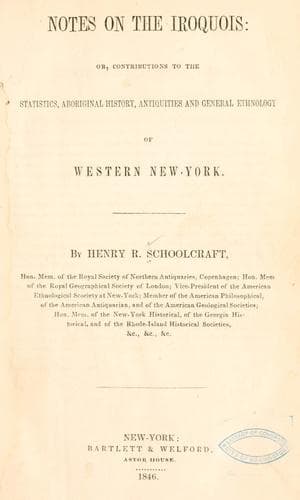
Notes on the Iroquois: or, Contributions to the Statistics, Aboriginal History, Antiquities and General Ethnology of Western New-YorkSchoolcraft, Henry Rowe
History
Notes on the Iroquois: or, Contributions to the Statistics, Aboriginal History, Antiquities and General Ethnology of Western New-York
Schoolcraft, Henry Rowe
Indians of North America -- New York (State); Iroquois Indians
The Seneca language has been somewhat cultivated. Mr. Wright, the
missionary, who has mastered the language, has printed a spelling book
of 112 pages, also a periodical tract for reading, called the “Mental
Elevator.” Both valuable philological data.
The Senecas of this reservation are on the move for Cattaraugus and
Alleghany, having sold out, finally, to the Ogden company. They leave
their old homes and cemetery, however, with “longing, lingering looks.”
Here lie the bones of Red Jacket and Mary Jemison.
Curious and interesting reminiscences the Senecas have. Jot down their
traditions of all sorts. Can’t separate fiction from fact. They must
go together; for often, if the fiction or allegory be pulled up, the
fact has no roots to sustain itself.
KAH-KWAHS, ERIES, ALLEGHANS,—who were they?
Mr. Wright showed me an ancient triturating stone of the Indians, in
the circular depressions of which they reduced the siliceous material
of their ancient pottery.
The Seneca language has a masculine, feminine and neuter gender. It has
also an animate and inanimate gender, making five genders.
It has a general and dual plural.
It abounds in compound descriptive and derivative terms, like the
Algonquin.
They count by the decimal mode. There are names for the digits to ten.
Twenty is a compound of two and ten, and thirty of three and ten, &c.
The comparison of adjectives is effected by prefixes, not by
inflections, or by changes of the words, as in English.
Nouns have adjective inflections as in the Algonquin. Thus _o-a-deh_ is
a road, _o-a-i-yu_ a good road. The inflection, in this last word, is
from _wi-yu_, good.
IRVING, CATTARAUGUS CREEK.
It is a maxim with the Iroquois, that a chief’s skin should be thicker
than that of the thorn locust, that it may not be penetrated by the
thorns.
Indian speakers never impugn each other’s _motives_ when speaking in
public council. In this, they offer an example.
Mr. Strong says, Silversmith of Onondaga, has the tradition of the war
with the Eries.
INDIANS IN CANADA.
It is observed by a report of the Canadian Parliament, that the number
of Indians now in Canada is 12,000. Of these, 3,301 are residing in
Lower Canada, and the remainder 8,862, in Canada West. The number
of Indians is stated to be on the increase, partly from the access
of births over the deaths, and partly from a numerous immigration
of tribes from the United States. This report must be taken with
allowances. It is, at best, but an estimate, and in this respect, the
Canadians, like ourselves, are apt to over estimate.
The Indian is a man who has certainly some fine points of character;
one would think a man of genius could turn him to account. Why then are
Indian tales and poems failures? They fail in exciting deep sympathy.
We do not feel that he has a heart.
Public-domain text, read in full here on John Shaqi.
Reviews
Reviews
No reviews yet
Be the first to share your thoughts on this work.
Elsewhere in the archive
Join the Discussion
Join the discussion
Sign in to leave a comment or review.
Sign InorCreate an account