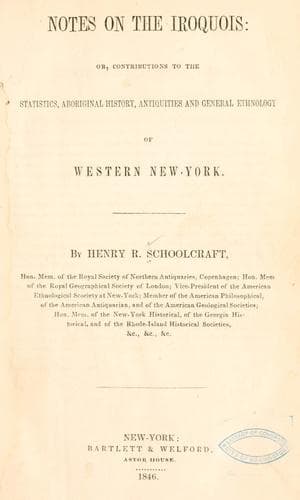
Notes on the Iroquois: or, Contributions to the Statistics, Aboriginal History, Antiquities and General Ethnology of Western New-YorkSchoolcraft, Henry Rowe
History
Notes on the Iroquois: or, Contributions to the Statistics, Aboriginal History, Antiquities and General Ethnology of Western New-York
Schoolcraft, Henry Rowe
Indians of North America -- New York (State); Iroquois Indians
There is an old story of buffaloes being killed here. Some say a horse
was killed by hungry _Frenchmen_, and palmed off for buffalo meat at
the camp. How came a horse _here_?
A curious bone needle was dug up this year, in some excavations made in
Fort Niagara, which is, clearly, of the age prior to the discovery.
Bones and relics must stand for the chronology of American antiquity.
America is the tomb of the red man. All the interest of its
anti-Columbian history, arises from this fact.
ERIES.
By Father Le Moyne’s letter of 1653, [vide Relacions,] the war with the
nation of the Cat or Eries was then newly broke out. He _thanks_ the
Onondagas, Senecas, Cayugas and Oneidas, for their _union_ in this war.
On the 9th August, 1653, we heard a dismal shout, among the Iroquois,
caused by the news, that three of their men had been killed by the
Eries.
He condoles with the Seneca nation, on the capture of their great
chief, AU-REN-CRA-OS, by the Eries.
He exhorts them to strengthen their “defences” or forts, to paint their
warriors for battle, to be united in council.
He required them never to lay in ambush for the Algonquin or Huron
nations, who might be on their way to visit the French.
We learn, from this, that the Eries or Cat nation, were not of the
Wyandot or Huron, nor of the Algonquin nations. It would seem that
these Eries were not friends of the French, and that by exciting them
to this new war, they were shielding their friends, the Algons and
Hurons, from the Iroquois club and scalping knife. That they were the
same people called the “Neuter Nation,” who occupied the banks of the
Niagara, there is but little reason to believe. The Senecas called them
Gawgwa or Kah-Kwah.
Cusick states that the Senecas fought against a people, west of the
Genesee river, called Squakihaw, _i. e._ Kah-Kwah, whom they beat, and
after a long siege took their principal fort, and put their chief to
death. Those who recovered were made vassals and adopted into the tribe.
He states that the banks of the Niagara river were possessed by the
Twa-kenkahor, or Missasages, who, in time, gave it up to the Iroquois
peaceably. Were not these latter the Neuter Nation?
To discuss the question of the war with the Eries, it is necessary
to advert to the geographical position of the parties. The Senecas,
in 1653, as appears by French authorities, lived in the area between
the Seneca lake and the Genesee river. The original stock of the
Five Nations appears to have entered the area of western New-York in
its central portions; and, at all events, they extended west of the
Genesee, after the Erie war, and possessed the land conquered from the
latter.
MISSION STATION, BUFFALO RESERVATION.
Seventy-four Seneca chiefs attended the general council held here.
Putting their gross population at 2,500, this gives one chief to every
thirty-three souls. This makes them “captains of tens.”
Public-domain text, read in full here on John Shaqi.
Reviews
Reviews
No reviews yet
Be the first to share your thoughts on this work.
Elsewhere in the archive
Join the Discussion
Join the discussion
Sign in to leave a comment or review.
Sign InorCreate an account