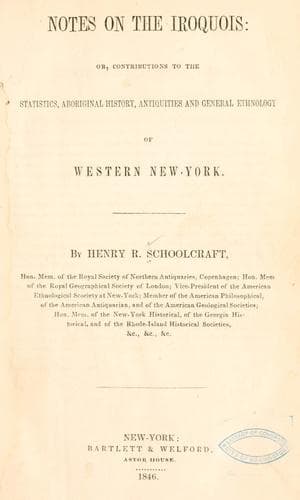
Notes on the Iroquois: or, Contributions to the Statistics, Aboriginal History, Antiquities and General Ethnology of Western New-YorkSchoolcraft, Henry Rowe
History
Notes on the Iroquois: or, Contributions to the Statistics, Aboriginal History, Antiquities and General Ethnology of Western New-York
Schoolcraft, Henry Rowe
Indians of North America -- New York (State); Iroquois Indians
Jemmy Johnson is the Great High Priest of the confederacy. Though now
69 years old, he is yet an erect, fine looking, and energetic Indian,
and is both hospitable and intelligent. He is in possession of the
medal presented by Washington to Red Jacket in 1792, which, among other
things of interest, he showed us.
It would be incompatible with the present purpose to describe all the
interesting men who there assembled, among whom were Capt. Frost,
Messrs. Le Fort, Hill, John Jacket, Dr. Wilson and others. We spent
most of Tuesday, and indeed much of the time during the other days of
the week in conversation with the chiefs and most intelligent Indians
of the different nations, and gleaned from them much information of
the highest interest in relation to the organization, government and
laws, religion, customs of the people, and characteristics of the
great men, of the old and once powerful confederacy. It is a singular
fact, that the peculiar government and national characteristics of the
Iroquois is a most interesting field for research and inquiry, which
has never been very thoroughly, if at all, investigated, although the
historic events which marked the proud career of the confederacy, have
been perseveringly sought and treasured up in the writings of Stone,
Schoolcraft, Hosmer, Yates and others.
Many of the Indians speak English readily; but with the aid and
interpretations of Mr. Ely S. Parker, a young Seneca of no ordinary
degree of attainment, in both scholarship and general intelligence,
and who, with Le Fort, the Onondaga, is well versed in old Iroquois
matters, we had no difficulty in conversing with any and all we chose
to.
About mid-day on Wednesday, the council commenced. The ceremonies
with which it was opened and conducted were certainly unique—almost
indescribable; and as its proceedings were in the Seneca tongue,
they were in a great measure unintelligible, and in fact profoundly
mysterious to the pale faces. One of the chief objects for which the
council had been convoked, as has been heretofore editorially stated
in the American, was to fill two vacancies in the sachemships of the
Senecas, which had been made by the death of the former incumbents;
and preceding the installation of the candidates for the succession,
there was a general and dolorous lament for the deceased sachems, the
utterance of which, together with the repetition of the laws of the
confederacy—the installation of the new sachems—the impeachment and
deposition of three unfaithful sachems—the elevation of others in
their stead, and the performance of the various ceremonies attendant
upon these proceedings, consumed the principal part of the afternoon.
Public-domain text, read in full here on John Shaqi.
Reviews
Reviews
No reviews yet
Be the first to share your thoughts on this work.
Elsewhere in the archive
Join the Discussion
Join the discussion
Sign in to leave a comment or review.
Sign InorCreate an account