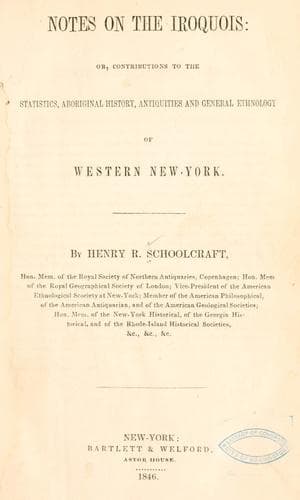
Notes on the Iroquois: or, Contributions to the Statistics, Aboriginal History, Antiquities and General Ethnology of Western New-YorkSchoolcraft, Henry Rowe
History
Notes on the Iroquois: or, Contributions to the Statistics, Aboriginal History, Antiquities and General Ethnology of Western New-York
Schoolcraft, Henry Rowe
Indians of North America -- New York (State); Iroquois Indians
Only two varieties of dancing were introduced the first evening—the
trotting dance and the fish dance. The figures of either are
exceedingly simple, and but slightly different from each other. In the
first named, the dancers all move round a circle, in a single file, and
keeping time in a sort of trotting step to an Indian song of yo-ho-ha,
or yo-ho-ha-ha-ho, as sung by the leaders, or occasionally by all
conjoined. In the other, there is the same movement in single file
round a circle, but every two persons, a man and a woman, or two men,
face each other, the one moving forward, the other backward, and all
keeping step to the music of the singers, who are now, however, aided
by a couple of tortoise or turtle shell rattles, or an aboriginal drum.
At regular intervals, there is a sort of cadence in the music, during
which a change of position by all the couples takes place, the one who
had been moving backward taking the place of the one moving forward,
when all again move onward, one-half of the whole, of course, being
obliged to follow on by _advancing backwards_!
One peculiarity in Indian dancing would probably strongly commend
itself to that class among pale faced beaux and belles denominated the
bashful; though perhaps it would not suit others as well. The men, or a
number of them, usually begin the dance alone; and the women, or each
of them, selecting the one with whom she would like to dance, presents
herself at his side as he approaches, and is immediately received into
the circle. Consequently, the young Indian beau knows nothing of the
tact required to handsomely invite and gallantly lead a lady to the
dance; and the young Indian maiden, unannoyed by obnoxious offers, at
her own convenience, gracefully presents her personage to the one she
designs to favor, and thus quietly engages herself in the dance. And
moreover, while an Indian beau is not necessarily obliged to exhibit
any gallantry as towards a belle, till she has herself manifested her
own good pleasure in the matter, so, therefore, the belle cannot
indulge herself in vascillant flirtations with any considerable number
of beaux, without being at once detected!
Public-domain text, read in full here on John Shaqi.
Reviews
Reviews
No reviews yet
Be the first to share your thoughts on this work.
Elsewhere in the archive
Join the Discussion
Join the discussion
Sign in to leave a comment or review.
Sign InorCreate an account