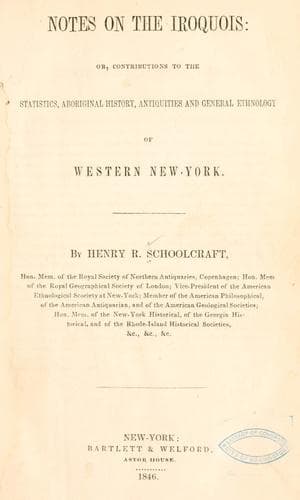
Notes on the Iroquois: or, Contributions to the Statistics, Aboriginal History, Antiquities and General Ethnology of Western New-YorkSchoolcraft, Henry Rowe
History
Notes on the Iroquois: or, Contributions to the Statistics, Aboriginal History, Antiquities and General Ethnology of Western New-York
Schoolcraft, Henry Rowe
Indians of North America -- New York (State); Iroquois Indians
assume the place of _the understanding_, was exhibited. Some of the
attitudes of the dancers, were really imposing, and the dance as a
whole, could be got up and conducted only by Indians! The women in the
performance of the corn dance, are quite by themselves—keeping time to
the beat of the shells, and gliding along sideways, without scarcely
lifting their feet from the floor.
It would probably be well, if the Indian every where, could be
inclined to refrain at least from the more grotesque and boisterous
peculiarities of this dance. The influence of these cannot be
productive of any good; and it is questionable whether it will be
possible, so long as they are retained, to assimilate them to any
greater degree of civilization or to more refined methods of living
and enjoyment, than they now possess. The same may be said of certain
characteristics of the still more vandalic war dance. This, however,
was not introduced at the council.
A part of the proceedings of Friday—the last day of the council, bore
resemblance to those of the preceding day. Jemmy Johnson resumed his
preaching; at the close of which the corn dance was again performed,
though with far more spirit and enthusiasm than at the first. Double
the numbers that then appeared—all hardy and sinewy men, attired
in original and fantastic style, among whom was one of the chiefs
of the confederacy, together with 40 or 50 women of the different
nations—now engaged and for two hours persevered in the performance
of the various, complicated and fatiguing movements of this dance. The
appearance of the dusky throng, with its increased numbers, and, of
course proportionably increased resources for the production of shrill
whoops and noisy stamping, and for the exhibition of striking attitudes
and rampant motions, was altogether strange, wonderful and seemingly
super-human.
After the dance had ceased, another kind of “sport,” a well contested
foot race, claimed attention. In the evening, after another supper
in the Council House, the more social dances,—the trotting, the
fish—and one in which the women alone participated, were resumed.
The fish dance seemed to be the favorite; and being invited to join
it by one of the chiefs, we at once accepted the invitation, and
followed in mirthful chase of pleasure, with a hundred forest children.
Occasionally the dances are characterised with ebullitions of merriment
and flashes of real fun; but generally a singular sobriety and decorum
are observed. Frequently, when gazing at a throng of 60 or perhaps an
hundred dancers, we have been scarcely able to decide which was the
most remarkable, the staid and imperturbable gravity of the old men
and women, or the complete absence of levity and frolicsomeness in the
young.
Public-domain text, read in full here on John Shaqi.
Reviews
Reviews
No reviews yet
Be the first to share your thoughts on this work.
Elsewhere in the archive
Join the Discussion
Join the discussion
Sign in to leave a comment or review.
Sign InorCreate an account