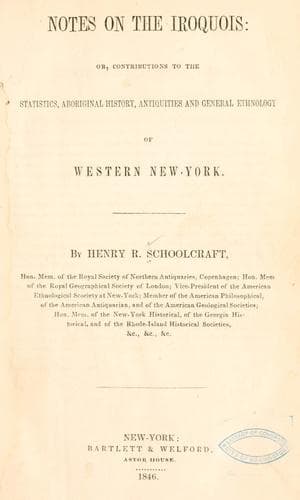
Notes on the Iroquois: or, Contributions to the Statistics, Aboriginal History, Antiquities and General Ethnology of Western New-YorkSchoolcraft, Henry Rowe
History
Notes on the Iroquois: or, Contributions to the Statistics, Aboriginal History, Antiquities and General Ethnology of Western New-York
Schoolcraft, Henry Rowe
Indians of North America -- New York (State); Iroquois Indians
DEAR SIR—Agreeable to your request I have been upon the
grounds in our vicinity once occupied as forts and places of defence.
So devastating has been the hand of time and the works of civilized
men, that little can now be possibly gleaned by observation. Our
main reliance in these matters must depend almost entirely upon the
recollections of early settlers and traditions. Many of these accounts,
as you are aware, are differently related by different individuals,
and not unfrequently in material points contradictory. From careful
investigation and inquiry I have been enabled to add a little to
what I had previously gathered and referred you to, in the New-York
Spectator. A locality in the town of Cazenovia, Madison co., near the
county line, and on Lot 33, Township of Pompey, Onondaga co., called
the “_Indian Fort_,” was not described in that paper. It is about
four miles southeasterly from Manlius village, situated on a slight
eminence, which is nearly surrounded by a deep ravine, the banks of
which are quite steep and somewhat rocky. The ravine is in shape like
an ox-bow, made by two streams, which pass nearly around it and unite.
Across this bow at the opening, was an earthen wall running southeast
and northwest, and when first noticed by the early settlers, was four
or five feet high, straight, with something of a ditch in front, from
two to three feet deep. Within this enclosure may be about ten or
twelve acres of land. A part of this ground, when first occupied in
these latter times, was called the “_Prairie_,” and is noted now among
the old men as the place where the first battalion training (military)
was held in the county of Onondaga. But that portion near the wall,
and in front of it, has recently, say five years ago, been cleared of
a heavy growth of black oak timber. Many of the trees were large, and
were probably 150 or 200 years old. Some were standing _in_ the ditch
and others _on the top_ of the embankment. There is a considerable
burying place _within_ the enclosure. The plough has already done much
towards leveling the wall and ditch; still they can be easily traced
the whole extent. A few more ploughings and harrowings and no vestige
of it will remain. The specimens of dark brown pottery I send with
this are from this locality. I picked them up at this visit. These
specimens are somewhat numerous upon this ground now. Almost every
variety of Indian relic has been found about here, but so fastidious
are the holders of them, that I have not been able to procure any for
you, and cannot, except _at a price_. However, they can be of little
consequence, as they are described in the article above referred to.
One fact, will, I think, apply to this locality, that does not belong
to any other of the kind in this region, that I know of. Two cannon
balls, of about 3 lbs. each, were found in the vicinity, showing that
light cannon were used, either for defence, or in the reduction of
this fortification.
Public-domain text, read in full here on John Shaqi.
Reviews
Reviews
No reviews yet
Be the first to share your thoughts on this work.
Elsewhere in the archive
Join the Discussion
Join the discussion
Sign in to leave a comment or review.
Sign InorCreate an account