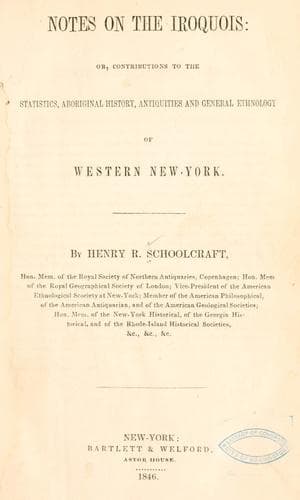
Notes on the Iroquois: or, Contributions to the Statistics, Aboriginal History, Antiquities and General Ethnology of Western New-YorkSchoolcraft, Henry Rowe
History
Notes on the Iroquois: or, Contributions to the Statistics, Aboriginal History, Antiquities and General Ethnology of Western New-York
Schoolcraft, Henry Rowe
Indians of North America -- New York (State); Iroquois Indians
There is a large rock in the ravine on the south,
on which are inscribed the following characters, thus, _IIIIIX_, cut
three-quarters of an inch broad, nine inches long, three-quarters of an
inch deep, perfectly regular, lines straight. Whether it was a work of
fancy, or had significance, I know not. Perhaps you may determine.
On the site of the village of Cazenovia, I am told there was a fort
or embankment; some persons say it was “_roundish_;” others that it
was “_angular, with sides at right angles_.” Recollections respecting
it are very imperfect. Many relics have been found here, indicating
an earlier occupancy than those usually found in this county. This
was on the Oneida’s territory. There is a singular coincidence in the
location of these fortifications which I have never observed until
my recent visit. They are nearly all, if not quite all, situated on
land rather elevated above that which is immediately contiguous,
and surrounded, or partly so, by deep ravines, so that these form a
part of the fortification themselves. At one of these (on the farm
of David Williams, in Pompey,) the banks on either side are found to
contain bullets of lead, as if shot across at opposing forces. The
space between may be about three or four rods, and the natural cutting
twenty or twenty-five feet deep. This only goes to show the care these
architects had in selecting the most favorable situations for defence,
and the fear and expectation they were in of attacks.
I do not believe any of the fortifications in this neighborhood are
more ancient than the period of the French settlement of missionaries
among the Onondagas, during the early part of the 17th century. But the
more I investigate, the more I am convinced that there were many more
of the French established here among the Indians, by far, than has been
generally supposed, and their continuance with them longer.
The nature of the articles found, utensils of farmers and mechanics,
hoes, axes, horseshoes, hammers, &c., go to prove that agriculture
was practised somewhat extensively, as well as the mechanic arts.
The Indian name by which it was anciently called, and is now, by the
natives, I think goes to substantiate this fact: “Ote-que-sah´-ē-ēh,”
an open place with much grass, an opening, or prairie. The timber
has a vigorous growth, and although in many places large, there is a
uniformity in the size and age, which shows that it has all grown up
_since_ the occupancy; because under the trees are not only found the
relics, but among them in many instances, corn hills can be traced in
rows at considerable distances.
Public-domain text, read in full here on John Shaqi.
Reviews
Reviews
No reviews yet
Be the first to share your thoughts on this work.
Elsewhere in the archive
Join the Discussion
Join the discussion
Sign in to leave a comment or review.
Sign InorCreate an account