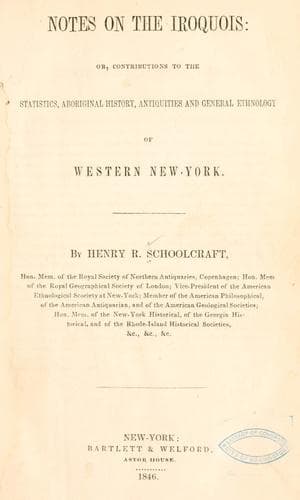
Notes on the Iroquois: or, Contributions to the Statistics, Aboriginal History, Antiquities and General Ethnology of Western New-YorkSchoolcraft, Henry Rowe
History
Notes on the Iroquois: or, Contributions to the Statistics, Aboriginal History, Antiquities and General Ethnology of Western New-York
Schoolcraft, Henry Rowe
Indians of North America -- New York (State); Iroquois Indians
1. The limestone pipe indicates the work of the savage, or aborigines.
2. The third indicates the age of French influence over the Indians. An
intelligent French gentleman says such clay pipes are frequent among
the town population in parts of France.
3. The second and most curious seems to indicate an earlier age and
people.
The beads found at Fort Hill are long and coarse, made of baked clay,
and may have had the same origin as the third pipe.
Fort Hill cannot have been formed by the French, as one of their posts
to aid in the destruction of the English colonies.
In 1689, or 156 years ago, the French in Canada made various attempts
to destroy the English colony of New-York. If the French had made Fort
Hill a post as early as 1660, or 185 years ago, and then deserted it,
the trees could not have grown to the size of the forest generally in
1810, or in 150 years afterwards. The white settlements had extended
only “twelve miles west of Avon” in 1798, and some years after 1800,
Fort Hill was covered with a dense forest. A chesnut tree cut down in
1842, at Rochester, showed 254 concentric circles of wood, and must
have been more than 200 years old in 1800. So opposed is the notion
that this was a deserted French post.
Must we not refer Fort Hill to that race which peopled this country
before the Indians, who raised so many monuments greatly exceeding the
power of the Indians, and who lived at a remote era?”
* * * * *
H. R. SCHOOLCRAFT, Esq.: I forward you the observations on
Fort Hill, for your use. My speculations are added for my pleasure, and
you will use them as you please. In great haste, I am obliged to close.
Your obedient,
C. DEWEY.
(H.)
Letter from Rev. Gilbert Rockwood to Henry R. Schoolcraft.
_Tuscarora Mission, August 1_, 1845.
SIR:—In the following communication, you can make use of such
statements as you may deem proper. If all the statements should not be
necessary for your official objects, yet they may be interesting to you
as an individual.
This mission was commenced about fifty years since, under the care of
the “New-York Missionary Society.” It was transferred to the “United
Foreign Mission Society,” in 1821, and to the “American Board of Com.
for Foreign Missions,” in 1826.
The church was organized in 1805, with five persons. The whole number
of native members who have united since its organization is 123. The
present number of native members is 53; others 5, total 58.
Between July 1st, 1844, and July 1st, 1845, there were only three
admissions, two by profession and one by letter.
About one-third of the population attend meeting on the Sabbath. Their
meeting house was built by themselves, with a little assistance from
abroad.
Public-domain text, read in full here on John Shaqi.
Reviews
Reviews
No reviews yet
Be the first to share your thoughts on this work.
Elsewhere in the archive
Join the Discussion
Join the discussion
Sign in to leave a comment or review.
Sign InorCreate an account