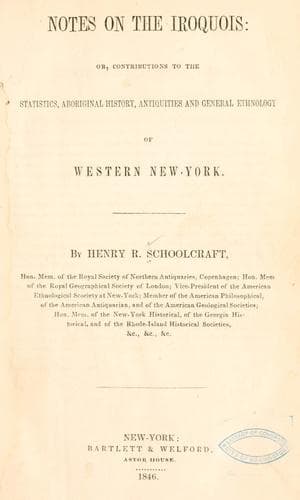
Notes on the Iroquois: or, Contributions to the Statistics, Aboriginal History, Antiquities and General Ethnology of Western New-YorkSchoolcraft, Henry Rowe
History
Notes on the Iroquois: or, Contributions to the Statistics, Aboriginal History, Antiquities and General Ethnology of Western New-York
Schoolcraft, Henry Rowe
Indians of North America -- New York (State); Iroquois Indians
The underlying rock is the hydraulic limestone of this section, which
is fully exposed at the falls of Allen’s Creek, half a mile south of
Fort-Hill. This rock was struck in digging the trench on the north line
in some places, and portions of it were thrown out with the earth.
Of the pipes found at F one was formed from granular limestone; one was
of baked clay, in the form of the rude outlines of a man’s head and
face, nose, eyes, &c., and it reminds one of the figures in some of
Stephens’ Plates of the ruins of Palenque. It has the hollows for the
ears to be fastened on, and shows no little effort. The top of the head
is surrounded by a fillet or wreath, and behind are two more fillets.
At the bottom of the neck is a similar ornament, and on the front is
another below it. This is the most curious.
Another pipe is of reddish baked clay, with some pits or dots for
ornament upon it, two rows of dots around it and another below like a
chain suspended at several points and curved by its own weight.
The forest has been removed. Not a tree remains on the quadrangle, and
only a few on the edge of the ravine on the west. By cultivating the
land, the trench is nearly filled in some places, though the line of
it is clearly seen. On the north side the trench is considerable, and
where the road crosses it, is three or four feet deep at the sides of
the road. It will take only a few years more to obliterate it entirely,
as not even a stump remains to mark out its line.
From this view it may be seen or inferred,
1. That a real trench bounded three sides of the quadrangle. On the
south side there was not found any trace of trench, palisadoes, blocks,
&c.
2. It was formed long before the whites came into the country. The
large trees on the ground and in the trench, carry us back to an early
era.
3. The workers must have had some convenient tools for excavation.
4. The direction of the sides may have had some reference to the four
cardinal points, though the situation of the ravines naturally marked
out the lines.
5. It cannot have been designed merely to catch wild animals to be
driven into it from the south. The oblique cut down to the spring is
opposed to this supposition, as well as the insufficiency of such a
trench to confine the animals of the forest.
6. The same reasons render it improbable that the quadrangle was
designed to confine and protect domestic animals.
7. It was probably a sort of fortified place. There might have been a
defence on the south by a _stockade_ or some similar means, which might
have entirely disappeared.
By what people was this work done?
The articles found in the burying ground at F. offer no certain reply.
The axes, chisels, &c. found on the Indian grounds in this part of the
State, were evidently made of the greenstone or trap of New-England,
like those found on the Connecticut river, in Massachusetts. The pipe
of limestone might be from that part of the country. The pipes seem to
belong to different eras.
Public-domain text, read in full here on John Shaqi.
Reviews
Reviews
No reviews yet
Be the first to share your thoughts on this work.
Elsewhere in the archive
Join the Discussion
Join the discussion
Sign in to leave a comment or review.
Sign InorCreate an account