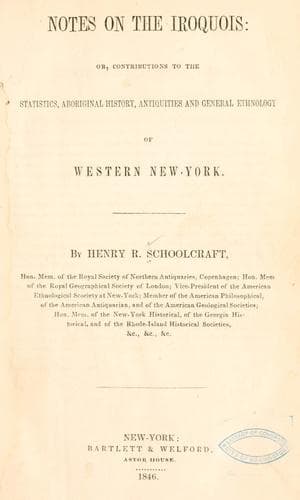
Notes on the Iroquois: or, Contributions to the Statistics, Aboriginal History, Antiquities and General Ethnology of Western New-YorkSchoolcraft, Henry Rowe
History
Notes on the Iroquois: or, Contributions to the Statistics, Aboriginal History, Antiquities and General Ethnology of Western New-York
Schoolcraft, Henry Rowe
Indians of North America -- New York (State); Iroquois Indians
348 Blessedness Kah yenh wah nunk.
349 Mankind Eh noo kenh’f.
350 The world Wah’f nah kwa kenh.
[112] If there is no infinitive, insert the form, he eats, &c.
* * * * *
NOTE.—As the above is intended to be used merely for
comparing one Iroquois dialect with another, I desire that our alphabet
may be used with the common English powers. If not, and you use a
particular system, please to state what sounds it expresses.
H. R. S.
There is nothing answering to the infinitive and participle. I have
therefore used the present indicative in the translation. I have
divided the words into syllables, whether they are simple or compound.
Where two or more words occur in the translation of a phrase, I have
separated them by a comma. I have used the English alphabet with
natural powers so far as Tuscarora sounds could be indicated by them.
It is impossible to give, in many cases, a correct sound. _A_ alone,
has the sound of _a_ in hate. Ah, like our interjection ah. The sound I
intend to indicate by sunh, keuh, heuh, would be given, very nearly, by
the Seneca alphabet used by Mr. Wright, thus: s_a_h, k_a_h, or k_a_h,
h_a_. The emphasis is, almost invariably, on the penultimate. Often a
slight emphasis on some others. There is also often a prolongation of
sound not indicated by any mark, as I supposed you would not need it.
I have not been able to finish this translation until now, (Oct. 20,)
as I was absent, or otherwise engaged for some time after you had left;
and when finally I was ready, Mr. Chew was not, until recently. I hope
it has not been too long delayed.
I received your letter from New-York, of Sept. 16th. Nicholas Cusick,
the father of James and David, was about 82 when he died. I have not
been able to learn where he was born. He died at this place October,
1840. I do not know that there was anything very peculiar about him. He
never was a “priest or juggler in his earlier days,” that I can learn.
Yours, truly,
GILBERT ROCKWOOD.
INQUIRIES.
There are several words in your vocabulary of the Tuscarora, in which
the sound of F is used, always, however, as a terminal sound, as in “Eh
noo keuh’f,” mankind.
Is this to be understood as denoting the ordinary sound of the letter?
Does it occur in other positions in words?
What is to be understood by the comma, which is invariably put before
it?
H. R. S.
_Tuscarora Mission_, _Dec. 6th_, 1845.
Public-domain text, read in full here on John Shaqi.
Reviews
Reviews
No reviews yet
Be the first to share your thoughts on this work.
Elsewhere in the archive
Join the Discussion
Join the discussion
Sign in to leave a comment or review.
Sign InorCreate an account