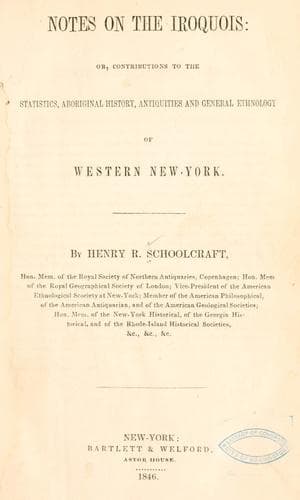
Notes on the Iroquois: or, Contributions to the Statistics, Aboriginal History, Antiquities and General Ethnology of Western New-YorkSchoolcraft, Henry Rowe
History
Notes on the Iroquois: or, Contributions to the Statistics, Aboriginal History, Antiquities and General Ethnology of Western New-York
Schoolcraft, Henry Rowe
Indians of North America -- New York (State); Iroquois Indians
Dear Sir—Your letter of December 1st is this day received. In
reference to the vocabulary of Indian words we furnished you, I have
further to remark, that the language having never been reduced to
writing, each individual undertaking to reduce any portion of it,
will have a system in part, at least, of his own. I have tried three
different ways myself. It is difficult, if not impossible, to represent
all the Tuscarora sounds by any combination of the English alphabet.
I presume a stranger to the language would not, with the use of the
vocabulary we have furnished you, give the correct sound in many
instances.
The letter _f_ terminating a word, has the sound of _f_ in _chief_.
I do not know as the comma before it, as in the word Eh noo keuh’f,
is of any use. In common conversation, or at any time when they speak
rapidly, the sound of _f_ is not distinguished, as a general thing.
Yet when they speak a word entire, there is this _f_ sound, slowly and
distinctly; it seems to be a distinct sound, or very nearly so. It
appears to be a little separated from the main part of the syllable,
as though another syllable was to follow immediately beginning with
f; but as soon as the sound of _f_, as in find, is given, the person
stops short. Thus instead of Eh noo keuh find, (I use the English
word _find_, because the power of _f_ in this word is the power of
the letter intended in the Indian word given,) we say Eh noo keuhf,
breaking off when you have given the sound of f, without proceeding to
give the sound of _ind_. Perhaps if a comma is used at all, it would
be more proper to place it _after_ the _f_, thus: f’; or the _f_ might
join the syllable, thus: Keuhf.
I do not recollect that the sound of _f_ is heard in any other part of
a word than as a terminating sound.
Sometimes an _r_ occurs separated, you will observe, by a comma from
the rest of the syllable. It matters not much whether the _r_ is joined
to the preceding or following syllable. There is the sound of an _r_
between them when the word is spoken. I have been puzzled to know where
to place it. It seems to answer either way. Thus, in the word for
to-morrow: Euh yuh’r heuh; or Euh yuh’ rheuh. If joined to the syllable
_yuh_, without being separated by the comma, you would pronounce it
very nearly like the English word _your_. As it is, thus, yuh’r, its
sound is very nearly like the English word _use_, and I am not sure but
that would be a preferable way of writing it, thus: Euh use heuh; yet
there is a twirl or _r_ sound you do not get as in the other mode of
writing it. R terminating a word has much the same sound.
Instead of using the word _find_ above, I might have used any other
word beginning with f. It has its ordinary sound.
Any other information you may wish, if in my power to give it, you may
be free to ask. Yours, truly,
G. ROCKWOOD.
(I.)
Letter from Rev. Asher Bliss to Henry R. Schoolcraft.
_Cattaraugus Mission, Sept. 4th, 1845._
Public-domain text, read in full here on John Shaqi.
Reviews
Reviews
No reviews yet
Be the first to share your thoughts on this work.
Elsewhere in the archive
Join the Discussion
Join the discussion
Sign in to leave a comment or review.
Sign InorCreate an account