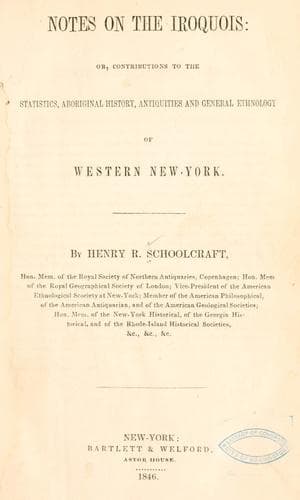
Notes on the Iroquois: or, Contributions to the Statistics, Aboriginal History, Antiquities and General Ethnology of Western New-YorkSchoolcraft, Henry Rowe
History
Notes on the Iroquois: or, Contributions to the Statistics, Aboriginal History, Antiquities and General Ethnology of Western New-York
Schoolcraft, Henry Rowe
Indians of North America -- New York (State); Iroquois Indians
A similar one is also found about two miles south of this, and, as is
this, it is on high ground, of circular form, and with a radius of
about one rod. They were discovered about thirty or thirty-five years
since. Nothing has been found in them, save human bones. The first,
some nine or ten years since, was nearly all ploughed up and scraped
into the road.
It is said that “sculls, arms and legs were seen on fences, stumps and
the high-way for a long time after they were drawn into the road.”
On, some two miles beyond the second was discovered a burial-ground.
At that place were ploughed up shell, bone, or quill-beads. Near this
place was found a brown earthen pot, standing between the roots of
a large tree, (maple, they think) and with a small sapling grown in
it, to some six inches in diameter. Beads of shell, bone or porcupine
quills have often been found. I would have remarked, that on the first
mound stood a hickory-tree some two feet through. There is also a ridge
at the termination of high ground; I say a ridge, it appeared to me to
be a regular fortification. It is, I should judge from thirty to forty
feet in length. It would appear that the ground was dug down from some
distance back, and wheeled to the termination of high ground, until
a bank is thrown up to a height of some fifteen or twenty feet. This
ridge, some think to be natural; others, from the fact that a smooth
stone, about the size and shape of a pestle, was found in it, think
it to be artificial. Perhaps other relics may have been found in it
that would show it to be an artificial formation. All I could learn
(and I rode about seven miles out of my way to converse with an old
inhabitant) was, that this pestle was found in the ridge, and within
three or four feet of its surface.
We may, perhaps, infer something from the size of an underjaw found
here, _which is said to have been so large as to much more than equal
that of the largest face in the country_.
Respectfully.
D. E. WALKER.
(O.)
Letter from H. C. Van Schaack, Esq. to Henry R. Schoolcraft.
_Manlius, July 18th, 1845._
DEAR SIR: Yours of yesterday from Jamesville is received.
Its enclosure is the first intimation I have of having been chosen a
corresponding member of the N. Y. Historical Society. I shall be happy
to advance the objects of the Society.
I regret that you have not found it convenient to call, I hope you will
still conclude to come. In the interim, I am convinced that Mr. C. can
advance your objects better than I can; he has read several addresses
on these subjects before the Literary Associations here and at Syracuse
within two years past.
Public-domain text, read in full here on John Shaqi.
Reviews
Reviews
No reviews yet
Be the first to share your thoughts on this work.
Elsewhere in the archive
Join the Discussion
Join the discussion
Sign in to leave a comment or review.
Sign InorCreate an account