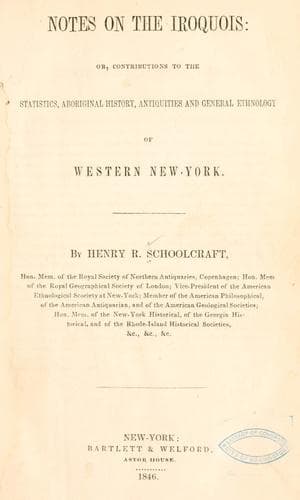
Notes on the Iroquois: or, Contributions to the Statistics, Aboriginal History, Antiquities and General Ethnology of Western New-YorkSchoolcraft, Henry Rowe
History
Notes on the Iroquois: or, Contributions to the Statistics, Aboriginal History, Antiquities and General Ethnology of Western New-York
Schoolcraft, Henry Rowe
Indians of North America -- New York (State); Iroquois Indians
We learn that at the establishment of the confederacy, fifty
sachemships were founded, and a name assigned to each, which they are
still known by, and which names every sachem of the several sachemdoms,
from the beginning to the present time, has borne. There were also
fifty sub-sachems, or aids; that is, to every sachem was given a
sub-sachem to stand behind him—in a word, to do his bidding. These
sachemships are still confined to the five nations; the Tuscaroras
were never permitted to have any. They are unequally divided among
the five nations, the Onondagas having as many as fourteen. The eight
original tribes or families still hold to be correct, as we had it,
but each tribe did not have a sachem. In some of the tribes were two
or three, in others none. As the English would say the Howard family
had a peerage in it, so would the Indians say that a certain tribe or
clan had one or two or no sachemships running in it. The idea seems to
be that the sachem did not preside over a tribe, as that would leave
some tribes destitute; but the nine Oneida sachems, for instance,
ruled the Oneida nation conjointly, and when the nations met in
council, would represent it. The fifty sachems were the only official
characters known at the councils of the confederacy. The sub-sachems
and chiefs had nothing to say. And unanimity, as in the Polish diet,
was always necessary. Over this council, the Tha-do-da-hoh, or great
sachem of the confederacy, presided. He was always taken from the
Onondagas, as we heretofore supposed; but what is very important, it is
denied that there was any such officer as a Tokarihogea, or military
chieftain over the confederacy. They recognize no such office, and
deny that Brant was any thing but a chief, or an officer of the third
and lowest class. I sifted this matter thoroughly, in conversations
with Blacksmith, La Fort, Capt. Frost, and Dr. Wilson, a Cayuga, and
am satisfied that the Tha-do-da-hoh[115] was the chief ruler of the
Iroquois, and that they had no other. We fell into this error by
following Stone, who in the Life of Brant, pretends to establish in
him the title of war chieftain or Tokarihogea of the confederacy. In
relation to the head warriors or military leaders of the nations, there
is still some obscurity. The Seneca nation has two, but the other
nations none. The truth is, the learning, if we may so call it, of the
Iroquois is in the hands of a few, and it is very difficult to reach
it, as those who are the most learned are the most inveterate Indians,
and the least communicative.
[115] This is a Seneca pronunciation of the name written
ATOTARHO, by Cusick, and Tatotarho, by another and older
authority. For a figure of this noted primary ruler, as it is given in
Iroquois picture writing, see page 132.
H. R. S.
Public-domain text, read in full here on John Shaqi.
Reviews
Reviews
No reviews yet
Be the first to share your thoughts on this work.
Elsewhere in the archive
Join the Discussion
Join the discussion
Sign in to leave a comment or review.
Sign InorCreate an account