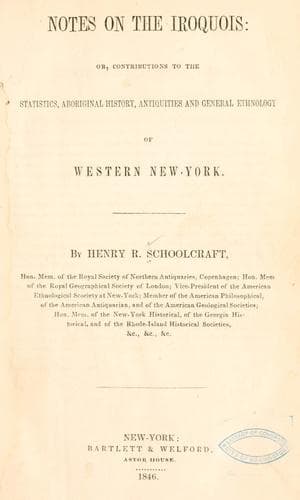
Notes on the Iroquois: or, Contributions to the Statistics, Aboriginal History, Antiquities and General Ethnology of Western New-YorkSchoolcraft, Henry Rowe
History
Notes on the Iroquois: or, Contributions to the Statistics, Aboriginal History, Antiquities and General Ethnology of Western New-York
Schoolcraft, Henry Rowe
Indians of North America -- New York (State); Iroquois Indians
Their laws of descent are quite intricate. They follow the female line,
and as the children always follow the tribe of the mother, and the
man never is allowed to marry in his own tribe, it follows that the
father and son are never of the same tribe, and hence the son can never
succeed the father, because the sachemship runs in the tribe of the
father. It really is quite surprising to find such permanent original
institutions among the Iroquois, and still more surprising that these
institutions have never seen the light. If I can construct a table of
descents with any approach to accuracy, I will send it down to the
Historical Society. The idea at the foundation of their law of descent,
is quite a comment upon human nature. The child must be the son of
the mother, though he may not be of his mother’s husband—quite and
absolutely an original code.
The object of this council was to “raise up sachems” in the place of
those who had died. It would require more room than twenty letters
would furnish to explain what we saw and heard—the mode of election
and deposition—the lament for the dead—the wampum—the two sides of
the council fire, &c. &c., and the other ceremonies connected with
raising up sachems; also the dances, the preaching, the feast.
We were well received by the Indians, and they seemed disposed to give
us whatever information we desired on the religious system of the
Iroquois, their marriage and burial rites, &c. Faithfully,
L. T. MORGAN.
NOTE.
In Mr. Cusick’s statement of his labors, he states that he has been
instrumental in forming _three_ churches, consisting of _two hundred
members_; but he omits noticing the locality and separate number of
these churches. The church over which he presides, at Tuscarora,
constitutes a part, but I am not able to say what part of the number.
He probably includes the Tonewanda church in the estimate; but, from
this uncertainty, it was impossible to bring either definitely into the
column of “church members.” A reference in the appropriate column of
the returns from Buffalo, denotes this church also to be “incomplete,”
as no return from the missionary, Mr. Wright, has been received,
and the interpreter, Mr. Pierce, who filled up the returns for that
station, dropped this column, after inserting _five_ names, under the
belief that the information would be given, and better given, by the
missionary himself.
Mr. Hall, of Alleghany, returns one more _school_ than appears in the
column of schools, an error which was not detected till the proof
sheets had been returned; nor is it known whether this includes
the schools kept by the Society of Friends on that reservation, no
information having been received from their local teacher, who was,
however, verbally requested to state the number of his pupils.
Public-domain text, read in full here on John Shaqi.
Reviews
Reviews
No reviews yet
Be the first to share your thoughts on this work.
Elsewhere in the archive
Join the Discussion
Join the discussion
Sign in to leave a comment or review.
Sign InorCreate an account