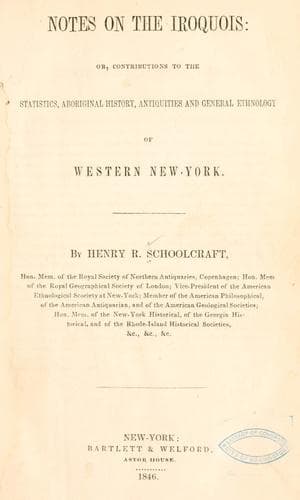
Notes on the Iroquois: or, Contributions to the Statistics, Aboriginal History, Antiquities and General Ethnology of Western New-YorkSchoolcraft, Henry Rowe
History
Notes on the Iroquois: or, Contributions to the Statistics, Aboriginal History, Antiquities and General Ethnology of Western New-York
Schoolcraft, Henry Rowe
Indians of North America -- New York (State); Iroquois Indians
The term by which they call themselves is NUNDOWAGA, or the
People of the Hill. A name which leads us at once to consider the
accounts of their own origin. Various relations of this story have been
given, differing in some of their details, but all coinciding in the
main events, namely: that they originated and lived on a well known
hill, at the head of Canandaigua lake, where they were put in eminent
peril of utter destruction by a monstrous serpent, which circled itself
about the fort and lay with its mouth open at the gate. The following
is given from a native source, and has some novel details to recommend
it.
While the tribe had its seat and council fire on this hill, a woman
and her son were living near it, when the boy, one day caught a small
two-headed serpent, called Kaistowanea, in the bushes. He brought it
home as a pet to amuse himself, and put it in a box, where he fed it
on bird’s flesh and other dainties. After some time it had become so
large that it rested on the beams of the lodge, and the hunters were
obliged to feed it with deer; but it soon went out and made its abode
on a neighboring hill, where it maintained itself. It often went out
and sported in the lake, and in time became so large and mischievous
that the tribe were put in dread of it. They consulted on the subject
one evening, and determined to fly next morning; but with the light of
the next morning the monster had encircled the hill and lay with its
double jaws extended before the gate. Some attempted to pass out, but
were driven back; others tried to climb over its body, but were unable.
Hunger at last drove them to desperation, and they made a rush to pass,
but only rushed into the monster’s double jaws. All were devoured but
a warrior and his sister, who waited in vain expectancy of relief.
At length the warrior had a dream, in which he was showed that if he
would fledge his arrows with the hair of his sister, the charm would
prevail over their enemy. He was warned not to heed the frightful heads
and hissing tongues, but to shoot at the heart. Accordingly, the next
morning he armed himself with his keenest weapons, charmed as directed,
and boldly shot at the serpent’s heart. The instantaneous recoiling of
the monster proved that the wound was mortal. He began in great agony
to roll down the hill, breaking down trees and uttering horrid noises,
until he rolled into the lake. Here he slaked his thirst, and tried
by water to mitigate his agony, dashing about in fury. At length he
vomited up all the people whom he had eaten, and immediately expired
and sunk to the bottom.[36]
[36] If this be viewed as an allegory, it may admit of this
interpretation. Internal feuds created by somebody brought up in their
own lodges, originated hatred and hot blood. In a long and bloody war,
the nation was nearly exterminated; at length the affections of a woman
prevailed. Harmony was restored, and a new era of prosperity began, by
removing the council fire to another place.
Public-domain text, read in full here on John Shaqi.
Reviews
Reviews
No reviews yet
Be the first to share your thoughts on this work.
Join the Discussion
Join the discussion
Sign in to leave a comment or review.
Sign InorCreate an account