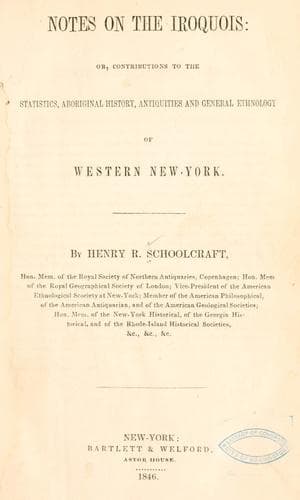
Notes on the Iroquois: or, Contributions to the Statistics, Aboriginal History, Antiquities and General Ethnology of Western New-YorkSchoolcraft, Henry Rowe
History
Notes on the Iroquois: or, Contributions to the Statistics, Aboriginal History, Antiquities and General Ethnology of Western New-York
Schoolcraft, Henry Rowe
Indians of North America -- New York (State); Iroquois Indians
To protect themselves from artillery, they had dug within
this wall, square pits of earth, six feet deep, covered with poles, and
connected by a wall of earth. They were well provided with corn and
ammunition, and had the means of standing a siege, had they made a wise
provision for water. To obtain this necessary article, they relied on
an artificial ditch leading to the stream.
[41] Hist. North Carolina.
To this aboriginal fort Col. Moore of South-Carolina, drove them from
the lower country with 40 musketeers and 800 Indians, in the early
part of the winter of 1713, after having been detained on his march
by a deep snow. He immediately saw the mistake of the water trench,
and placed cannon to rake it. He then fortified the only passage or
point of land, where the Indians would be likely to escape, and began
regular approaches to the work, which he entered on the 26th of March,
1713, taking 800 Tuscaroras prisoners. It is not said how many were
killed. He had lost of his army, during the siege, 22 white, and 36 red
men killed, and 29 of the former, and 50 of the latter wounded. The
Cherokees and their allies claimed the prisoners, who were taken to
the south, and sold as slaves, a part, as we are left to infer, being
offered by the southern Indians, to appease the spirit of retaliation
for prior losses by them.
This brought the tribe to terms, and they entered into preliminaries
of peace, by which they agreed to deliver up twenty men, who were the
contrivers of the plot, and who took Lawson and Graffenried; to restore
all prisoners, horses and cattle, arms and other property; to treat
and pursue the Mattamuskeets and their other allies, as enemies; and
finally, to give two hostages for the peaceable conduct of each of
their towns.
During the following summer, the chief called “King Blount,” brought in
thirty scalps from his miserably treated allies; “but the greater part
of the nation,” says the historian before quoted, “unable to contend,
and unwilling to submit, removed to the northward, and joined the
Seneca, and other confederate tribes on the frontiers of New-York.[42]
Those who remained, were to have settled between the Neuse and Taw
rivers; but an Indian war having broken out in the southern colonies
in 1715, only three months after the peace, with the Corees and their
other former allies, the Tuscaroras, now the remains of a broken down
tribe, feeble in numbers and power, obtained permission to settle on
the _north_ side of the Roanoke river, on a reservation, where some of
them were living in 1803.
[42] Williamson.
Public-domain text, read in full here on John Shaqi.
Reviews
Reviews
No reviews yet
Be the first to share your thoughts on this work.
Elsewhere in the archive
Join the Discussion
Join the discussion
Sign in to leave a comment or review.
Sign InorCreate an account