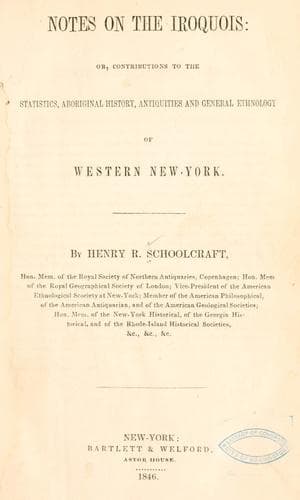
Notes on the Iroquois: or, Contributions to the Statistics, Aboriginal History, Antiquities and General Ethnology of Western New-YorkSchoolcraft, Henry Rowe
History
Notes on the Iroquois: or, Contributions to the Statistics, Aboriginal History, Antiquities and General Ethnology of Western New-York
Schoolcraft, Henry Rowe
Indians of North America -- New York (State); Iroquois Indians
The whole number of Indians living in North Carolina in 1708,
estimating their fighting men, were 1,608, of whom, the Tuscaroras
constituted 1,200, which would give them, on the ordinary principle
of estimating their population, 6,000 souls. Two thirds of the whole
number of their fighting men were captured at the taking of fort
NAHARUKE in 1713. How many were killed on other occasions is
not certainly known; but it is probable that in this short war of but
three years duration, and owing to the desertion of families, death by
sickness, want, and other casualties consequent upon the surrender of
Naharuke, they sunk to almost immediate insignificance. Those who fled
to their kindred in western New-York, were never counted. They were
estimated, perhaps high, at 200 warriors, in 1776. They were located at
first, immediately west of, and in juxtaposition to the Oneidas, along
with whom, they are mentioned as being secured in their rights, by the
treaty of Fort Stanwix, in 1784. But in fact, they had no independent
claim to territory, living merely as guests, although the confederacy
had admitted them as an integral member, after their disastrous flight
from North Carolina, calling themselves no longer the FIVE,
but the SIX NATIONS. The Senecas gave them lands on the
Niagara Ridge, after the American revolution; these were subsequently
secured to them in a reservation made by the State, in the present
bounds of Niagara county. Here they have continued to dwell, having
added to their possessions, by an early purchase from the Holland Land
Company, made with the avails of the sale of their reservation north of
the Roanoke, in North Carolina.
But if the Tuscaroras have erred in policy, and sunk in numbers,
with a rapidity and in a ratio unequalled by any other members of
the confederacy, if we except the Onondagas and Cayugas, they may be
said to have grown wise by experience. Low as their present numbers
are, they hold an exalted rank among their brethren for industry,
temperance, and their general advance in arts, agriculture and morals.
I found, on making the enumeration, 283 persons living in 53 families,
of whom 151 were males and 167 females. These families cultivated the
past year 2,080 acres of land, on which they raised 4,897 bushels of
wheat, 3,515 of corn, 4,085 of oats, 1,166 of potatoes, besides limited
quantities of peas, beans, buckwheat and turnips. They possess 336 neat
cattle, 98 milch cows, making 7,537 pounds of butter, 153 horses, 215
sheep, and 596 hogs.
Public-domain text, read in full here on John Shaqi.
Reviews
Reviews
No reviews yet
Be the first to share your thoughts on this work.
Elsewhere in the archive
Join the Discussion
Join the discussion
Sign in to leave a comment or review.
Sign InorCreate an account