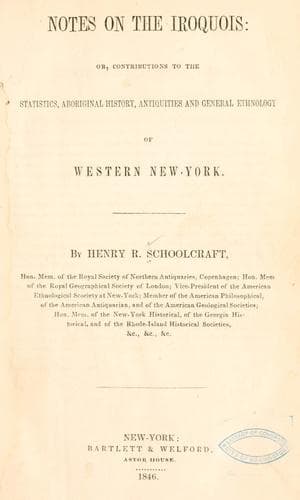
Notes on the Iroquois: or, Contributions to the Statistics, Aboriginal History, Antiquities and General Ethnology of Western New-YorkSchoolcraft, Henry Rowe
History
Notes on the Iroquois: or, Contributions to the Statistics, Aboriginal History, Antiquities and General Ethnology of Western New-York
Schoolcraft, Henry Rowe
Indians of North America -- New York (State); Iroquois Indians
When it is considered that this enumeration gives an average of six
neat cattle, three horses, (nearly) two milch cows, (nearly) 10 hogs,
and 92 bushels of wheat, 966 of corn to each family, their capacity
to sustain themselves, and their advance as agriculturists will be
perceived. Fifty-nine ploughs were found amongst fifty-three families.
They cut 195 acres of meadow to sustain their cattle. They have over
1,500 fruit trees, and dwell in excellent frame or square-timber
houses, well finished, and for the most part well furnished. I noticed
one edifice of stone, in the process of building, seated on rising
grounds, amidst shade trees, which denotes both wealth and taste. Other
results of civilization are to be already observed. Among these there
are no slight indications of classes of society, arranging themselves,
as rich and poor, intelligent and ignorant, industrious and idle, moral
and immoral.
Of the entire population, 63 are church members, and 231 members of
temperance societies, which is a far higher proportion than is found in
any other of the cantons.
[_g._] Necariages.
The Tuscaroras were probably admitted into the confederacy about 1714.
Nine years afterwards the Iroquois received the Nicariages. Under
this name the long expatriated Quatoghies, or Hurons, then living at
Teiodonderoghie or Michilimackinac, were taken into the confederacy as
the Seventh Tribe, or canton. This act was consummated in the reign of
George II., at a public council held at Albany on the 30th May, 1723,
on their own desire. A delegation of 80 men, who had their families
with them, were present. Of this curious transaction but little is
known. For although done in faith, it was not perceived that a tribe
so far separated from the main body, although now reconciled, and
officially incorporated, could not effectually coalesce and act as
one. And accordingly, it does not appear, by the subsequent history
of the confederacy, that they ever came to recognize, permanently,
the Necariages as a Seventh Nation. The foundation for this act of
admission had been laid at a prior period by the daring and adroit
policy of Adario, who had so skilfully contrived to shift the atrocity
of his own act, in the capture of the Iroquois delegates on the St.
Lawrence, on the Governor-General of Canada.
It has been mentioned, in a preceding page of this report, that
the Iroquois recommended their political league as a model to the
colonies, long before the American revolution was thought of. And
it is remarkable that its typical character, in relation to our
present union, should have been also sustained, in the feature
of the admission, if not “annexation,” of new tribes, who became
equal participants of all the original rights and privileges of the
confederacy.
[_h._] St. Regis Colony, or Band.
Public-domain text, read in full here on John Shaqi.
Reviews
Reviews
No reviews yet
Be the first to share your thoughts on this work.
Elsewhere in the archive
Join the Discussion
Join the discussion
Sign in to leave a comment or review.
Sign InorCreate an account