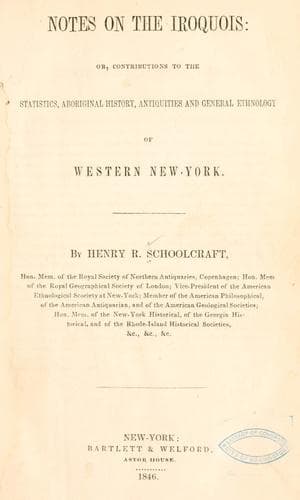
Notes on the Iroquois: or, Contributions to the Statistics, Aboriginal History, Antiquities and General Ethnology of Western New-YorkSchoolcraft, Henry Rowe
History
Notes on the Iroquois: or, Contributions to the Statistics, Aboriginal History, Antiquities and General Ethnology of Western New-York
Schoolcraft, Henry Rowe
Indians of North America -- New York (State); Iroquois Indians
This community is an off-shoot of the Iroquois stock, but not a member
of the confederacy. It originated in the efforts commenced about the
middle of the 17th century, by the Roman Catholic church of France, to
draw the Iroquois into communion with that church. It was, however, but
a part of the public policy, which originated in the reign of Louis
XV., to colonize the Iroquois country, and wrest it from the power of
the British crown. When this effort failed,—replete as it was with
wars, intrigues and embassies, battles and massacres, which make it the
heroic age of our history, the persons who had become enlisted in the
ritual observances of this church, were induced to withdraw from the
body of the tribes, and settle on the banks of the St. Lawrence, in
the area of the present county of St. Lawrence. It was, in effect, a
missionary colony. Its members were mostly Mohawks, from Caughnawaga,
with some Oneidas, and perhaps a few of the Onondagas, amongst whom
there had been Catholic missions and forts established, at early dates.
The exertions made to organize this new canton were, politically
considered, at direct variance with the colonial policy of New-York,
and were therefore opposed by the persons entrusted by the crown with
Indian affairs, and also by the councils of the confederacy.
Those persons who composed it assimilated in faith, and almost as a
necessary consequence, they soon did so in politics.[43] They went off
in small parties, secretly, and after they had become embodied and
located, they were regarded, in effect, as foreign Indians, and were
never recognized or admitted to a seat in the confederacy. The feeling
caused by this separation, among the tribes themselves, amounted to
bitterness, and it is a feeling which, I had occasion to observe on one
occasion, is not forgotten by the existing cantons even at this day.
[43] Some exceptions to this existed. The noted chief called Col.
Louis, who rendered the American cause such essential service, during
the siege of Fort Stanwix, in 1777, was of the St. Regis tribe,
agreeably to information given to me, at Oneida Castle, the present
year, by Abraham Dennie.
The St. Regis colony increased rapidly, but had some extra stimulants
to promote its growth, its success being equally dear to the political
and ecclesiastical policy of France. It became a thorn to the frontier
towns and settlements of New-England, during the whole of the old
French war, so called, and of the American revolution. Some of the
forays of this band into the Connecticut valley were productive of
thrilling and heart rending events, as those must have realized who
have had their youthful sympathies excited by narrations of the
touching captivities of the Hows and the Williams, of that valley.
Public-domain text, read in full here on John Shaqi.
Reviews
Reviews
No reviews yet
Be the first to share your thoughts on this work.
Elsewhere in the archive
Join the Discussion
Join the discussion
Sign in to leave a comment or review.
Sign InorCreate an account