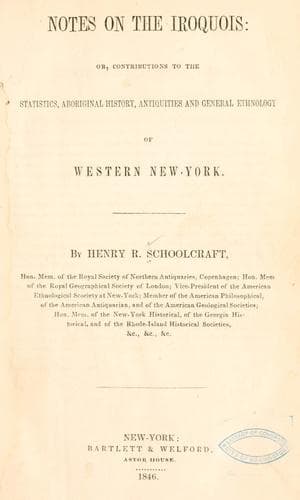
Notes on the Iroquois: or, Contributions to the Statistics, Aboriginal History, Antiquities and General Ethnology of Western New-YorkSchoolcraft, Henry Rowe
History
Notes on the Iroquois: or, Contributions to the Statistics, Aboriginal History, Antiquities and General Ethnology of Western New-York
Schoolcraft, Henry Rowe
Indians of North America -- New York (State); Iroquois Indians
Two elementary powers existed at an early day in the Iroquois cantons,
namely, the civil and war chieftainships. There is abundant evidence,
both in their own traditions, and in existing antiquarian remains, to
show that they were at variance, in the early periods of their history,
and fought against each other, and built fortifications to defend
themselves. Partial leagues would naturally fail. League after league
probably took place. When they came to see the folly of such a course,
and proposed to confederate on enlarged principles, and direct their
arms exclusively against others, the question doubtless arose, how
they should be represented in the general council. It is clear, from
the preceding remarks on the era of the confederation, whatever age we
assign to the era itself, that the Rakowanas,[48] or leading chiefs of
each of the five cantons, did not assemble. Power was assigned to, and
concentrated on one individual, who stood as the federal representative
of his canton in its sovereign capacity. It was only to the Senecas
that two representatives, of this senatorial dignity, were assigned; a
conclusive evidence that they were, at this era, estimated at double
the numerical strength of the highest of the other four cantons. By
these six men, who appear rather in the capacity of ambassadors,
forming the principles of a treaty, or league, the modern confederacy,
as known to us, was organized. Tradition says that this treaty of
alliance was held at Onondaga, where the central council fire of the
confederacy, organized under it, was also originally fixed, and has
permanently remained. Of the nature and powers of this general council,
or congress of sachems, acting for the whole cantons, some views are
expressed in the following paper.
[48] Mohawk.
[_c._] Principles of the Iroquois Government.
Public-domain text, read in full here on John Shaqi.
Reviews
Reviews
No reviews yet
Be the first to share your thoughts on this work.
Elsewhere in the archive
Join the Discussion
Join the discussion
Sign in to leave a comment or review.
Sign InorCreate an account