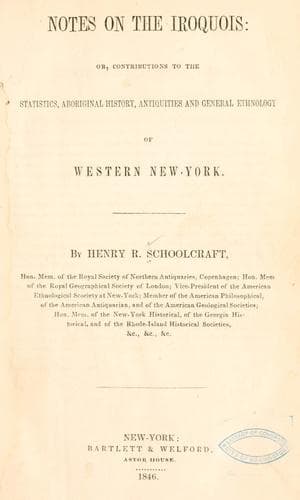
Notes on the Iroquois: or, Contributions to the Statistics, Aboriginal History, Antiquities and General Ethnology of Western New-YorkSchoolcraft, Henry Rowe
History
Notes on the Iroquois: or, Contributions to the Statistics, Aboriginal History, Antiquities and General Ethnology of Western New-York
Schoolcraft, Henry Rowe
Indians of North America -- New York (State); Iroquois Indians
No one has attended to the operations of the Iroquois government
and polity, as they are developed in their councils and meetings
for general consultation and action, without perceiving a degree of
intricacy in its workings, which it is difficult to grasp. Or rather,
the obscurity may be said to grow out of the little time and the
imperfect opportunities which casual observers have to devote to the
object. For, maturely considered, there is no inherent difficulty in
the way. It seems clear that they came together as independent tribes,
who, at an early age, had all proceeded from the same parental stock,
but who, after an indefinite period of fightings and wars, became
convinced of the short-sightedness of such a course, and fell on the
plan of a confederation which should produce general action, and yet
leave the several members free, both in their internal polity, and
in the exercise of most of their co-tribal powers. It was clearly a
confederation for common purposes of defence and offence, and not a
perfect union. Each tribe, or more properly speaking, canton, was still
governed by its own chiefs, civil and military. They came together in
general councils, by sachems, exercising the power of delegates.
These delegates or sages came in their hereditary or elective
character, as the case might be, or as the customs and laws of the
tribe in its popular character had decided. But their voices were,
in all cases, either prompted by prior expressions of the warriors
and wise men, or were to be ratified by these known powers. However
invested with authority they but spoke the popular will. The relative
power of the cantons is denoted, and appears as a question that
was already settled, at the first formal general council for the
purpose of confederating. For we there see precisely the same tribal
representation, which has obtained ever after and still prevails; that
is to say, the Mohawks, the Oneidas, the Onondagas, and the Cayugas,
had each one chief, and the Senecas two, making six supreme dignitaries
or state counsellors. That their powers were merely advisory and
interlocutory, and that they aimed to come to harmonious results, by
the mere interchange of opinion, without any formal or solemn vote, is
evident, from all that we know, or can gather from their still existing
institutions. There appeared to have been no penalties—no forfeiture
of rights—no binding or coercive power, to be visited on tribes or
chiefs beyond that of OPINION. Popular disapproval was the
Iroquois penalty here and elsewhere. It is equally clear, however,
that a single negative voice or opinion, was of the highest efficacy.
A unanimous decision, not a decision on the majority principle, was
required. The latter was a refinement, and an advance in polity, which
they had not certainly reached, although they seem inclined now to
follow it; and herein we may perceive the great power and efficacy of
their old decisions. These decisions were, in their effects, clothed
Public-domain text, read in full here on John Shaqi.
Reviews
Reviews
No reviews yet
Be the first to share your thoughts on this work.
Elsewhere in the archive
Join the Discussion
Join the discussion
Sign in to leave a comment or review.
Sign InorCreate an account