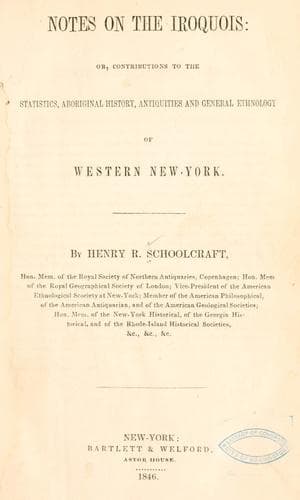
Notes on the Iroquois: or, Contributions to the Statistics, Aboriginal History, Antiquities and General Ethnology of Western New-YorkSchoolcraft, Henry Rowe
History
Notes on the Iroquois: or, Contributions to the Statistics, Aboriginal History, Antiquities and General Ethnology of Western New-York
Schoolcraft, Henry Rowe
Indians of North America -- New York (State); Iroquois Indians
But how, it may be asked, is a government so purely popular, and so
simple and essentially advisory in its character, to be reconciled with
the laws of hereditary descent, fixed by the establishment of heraldic
devices, and bringing its proportion of weak and incompetent minds
into office, and with the actual power it exercised, and the fame it
acquired? To answer this question, and to shew how the aristocratic
and democratic principles were made to harmonize, in the Iroquois
government, it will be necessary to go back, and examine the law of
descent among the tribes, together with the curious and intricate
principles of the TOTEMIC BOND.
Nothing is more fully under the cognizance of observers of the manners
and customs of this people, than the fact of the entire mass of a
canton or tribe’s being separated into distinct clans, each of which
is distinguished by the name and device of some quadruped, bird, or
other object in the animal kingdom. This device is called, among
the Algonquins, (where the same separation into families or clans,
exists,) TOTEM, and we shall employ the term here, as being
already well known to writers. But while the Algonquins have made
no other use of it, but to trace consanguinity, or at least, remote
affinities of families, and while they have also separated into wild
independencies and tribes, who have assumed new tribal names, and
wandered and crossed each other’s track and boundaries in a thousand
ways, the Iroquois have turned it to account by assuming it as the very
basis of their political and tribal bond. How far fixity of territorial
possession and proximity of location may have favored or led to the
establishment of this new bond, need not be inquired into here, but,
while we express no opinion favorable to the remote antiquity of their
residence in the north, it must be evident that this tie would have
lost all its binding force if the Alleghanies, the Great Lakes, or
any other very wide geographical areas, had been interposed between
them, and thus interrupted frequent and full intercourse and united
action. A government wholly verbal, must be conceded to have required
this proximity and nearness of access. The Senecas may be selected as
an example of the influence of the Totemic bond. This canton is still
the most numerous of the existing Iroquois tribes. By the recent
census, the results of which accompany these papers, they number over
two thousand four hundred souls. This population is, theoretically,
separated into eight clans or original families, who are distinguished
respectively by the totems of the wolf, the bear, the turtle, the deer,
the beaver, the falcon, the crane and the plover. Theory at this time,
founded doubtless on actual consanguinity in their inceptive age, makes
these clans brothers. It is contrary to their usages that near kindred
should intermarry, and the ancient rule interdicts all intermarriage
between persons of the same clan. They must marry into a clan whose
Public-domain text, read in full here on John Shaqi.
Reviews
Reviews
No reviews yet
Be the first to share your thoughts on this work.
Elsewhere in the archive
Join the Discussion
Join the discussion
Sign in to leave a comment or review.
Sign InorCreate an account