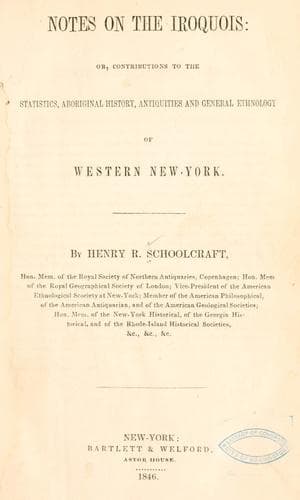
Notes on the Iroquois: or, Contributions to the Statistics, Aboriginal History, Antiquities and General Ethnology of Western New-YorkSchoolcraft, Henry Rowe
History
Notes on the Iroquois: or, Contributions to the Statistics, Aboriginal History, Antiquities and General Ethnology of Western New-York
Schoolcraft, Henry Rowe
Indians of North America -- New York (State); Iroquois Indians
with all the power of the most full popular will. For what each of the
senatorial chiefs or delegates, and all the cantons, pronounced proper,
there was no one, in a patriarchal community, to lisp a word against.
So little power was abstracted from each tribe, and conceded to the
federative council as a fixed government, that it seems not without
scrutiny, that we can perceive there is _any_. This is, however,
certain. One of the six primary sachems, was selected to preside over
the general councils. His power was, however, exclusively of a civil
character, and extended but little beyond that of a moderator, but he
was a moderator for life, or during the time he retained the right
and full use of his faculties, or until just cause of dissatisfaction
should bring the question of a successor before the council. This head
officer, had also authority to light the council fire,—that is to
say, he could send messengers, and was if so desired, bound to send
messengers to assemble the general council. The act, and the symbol of
the act were both in his hands. He summoned the chiefs, and actually
lit the sacred fire, at whose blaze their pipes were lighted. Thus
limited, and having no other administrative power, but to appoint his
own Har-yar-do-ah, aid or pipe-bearer, and messengers, he enjoyed his
executive dignity; but had little more power when the sessions were
closed, than belonged to every leading chief of the component tribes.
He was himself bound to respect the messages of the tribal chiefs,
and receive the runners who were sent to him from the frontiers with
news, and he thus performed merely and exactly the will of each tribe,
thus expressed. He was never in advance of the popular will. The whole
hereditary machinery was made subservient to this. And he was limited
to the performance of these slender, and popular duties. He might,
it is true, if a man of eloquence, talents or bravery, be also the
ruling civil chief of his tribe, and furthermore, its war captain in
the field. And such is known to have actually been the character and
standing of Atotarho, the first presiding chief in their federative
councils. He was a man of energy and high renown. And such was the
estimation in which he was held in his life time, and the popular
veneration for his character after death, that as above denoted,
his name became the distinctive title for the office. Thus much is
preserved by tradition, and the office and title of the Atotarho as
presiding sachem, is not yet extinct, although the tribes have no
longer wars to prosecute, or foreign embassadors to reply to.
Public-domain text, read in full here on John Shaqi.
Reviews
Reviews
No reviews yet
Be the first to share your thoughts on this work.
Elsewhere in the archive
Join the Discussion
Join the discussion
Sign in to leave a comment or review.
Sign InorCreate an account